 Shaun Tan is an internationally known Australian author and artist of picture books. He has won an Academy Award (Best Animated Short–The Lost Thing) and the Astrid Lindgren Memorial Award, one of the highest achievements in children’s literature. My first introduction to Shaun Tan was the graphic novel The Arrival, which I read when it was published in the U.S. in 2007. I was immediately captivated by the complex details of this wordless story about an immigrant to an unknown land. Tan’s drawings evoke the sepia tones of early 19th century photographs from Ellis Island, but his world contains odd creatures, strange customs and an indecipherable language–eliciting a strong empathy for the plight of everyone who lands in a new country without understanding the language. As I continued to find and read other stories by Tan, I found that they all evoked that same sense of empathy and wonder–wonder at the strangeness and mystery of his unusual landscapes and empathy for his outsider characters.
 Tan often focuses on an object or a character that has been lost–the protagonist of The Arrival or the odd teakettle shaped item in The Lost Thing being two primary examples. Other stories such as The Red Tree communicate emotional turmoil in visceral poetic images. Everyone that I have shown this story to has responded to at least one of the spreads by saying “I know that exact feeling!” Tan also works with material that takes characters through some kind of change, either minor or monumental. In the story ‘the nameless holiday’ from Tales from Outer Suburbia, people choose to give up something
  special, while in John Marsden’s post-colonial allegory The Rabbits, a civilization is gradually overcome by invaders. From deserts to massive cities, from magical rooms hidden inside houses to backyards filled with brightly painted missiles, Tan draws the reader into the world of his tales with illustrations comprised of collage, nuanced shading, saturated color and precise drafting. Some stories clearly share visual characteristics–the story ‘Eric’ from Tales from Outer Suburbia uses the same quiet greyscale and tiny details as The Arrival–but the Renaissance influenced spreads from the story ‘no other country’ contrast strongly with the torn paper collages from ‘distant rain.’ No matter what the medium, Tan never fails to elicit compassion for his characters–whether they are an immigrant family or scraps of paper in someone’s pocket.
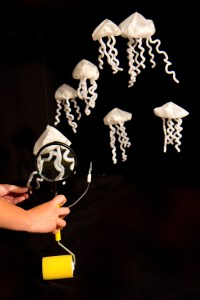
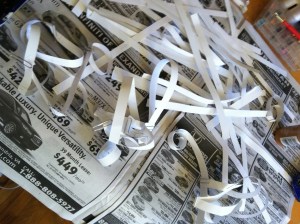
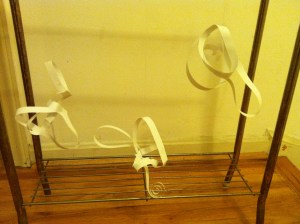
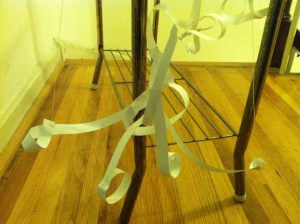
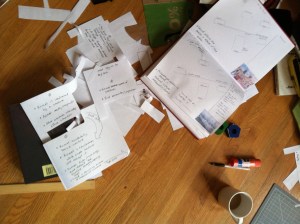
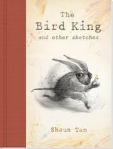 In a 2011 interview with the German newspaper Der Spiegel (you can view it here.) Tan responded to questions with simple illustrations, resulting in some hilarious, succinct responses. I especially like the depiction of Hollywood as a snow globe and Tan’s childhood dream to become either an astronaut or an artist. In the introduction to his most recent publication The Bird King and other sketches, Tan talks about how for him, images “…are not pre-conceived and then drawn, they are conceived as they are drawn. Indeed, drawing is its own form of thinking, in the same way birdsong is ‘thought about’ within a bird’s throat.” This is very similar to how a lot of our work on Kismet has been constructed. We look at materials, arrange and combine them, and start experimenting with movement and interactions. Tan has been our primary inspiration on this project and we look forward to continuing to learn from his work and stories as we create our own.








 Wit's End Puppets