Adventures in Interviewing

IMG_1962We have a busy year ahead of us! Along with remounts of several collaborative projects and our ongoing development of Malevolent Creatures, we are creating a new shadow puppet play called Saudade. 

It’s a project based on stories of the immigrant experience and right now I’m doing lots of interviews with people in Washington DC, Virginia and Maryland. I’ve heard many different perspectives, but everyone seems to agree that the two things that make us long for the places we come from are family and food. I’m looking forward to working on assembling the many moments I’m hearing about into a beautiful shadow play experience!

An Interview with Amelia Gossman

This week Wit’s End Artistic Director Cecilia Cackley interviewed artist Amelia Gossman about her experience working as an illustrator on Malevolent Creatures, our upcoming project based on British and Celtic folklore.  

Cecilia Cackley: When did you first learn about the character of Black Annis (aka Black Agnes)? What drew you to her?

Black Annis, artwork by Amelia Gossman

Black Annis, artwork by Amelia Gossman

Amelia Gossman:  As a kid, I was really into folklore and faeries. My best friend and I would look at Brain Froud books when we were eight and run around the woods looking for and trying to lure the creatures we read about. I believe in his book, “Good Faeries/ Bad Faeries” he gives a brief description of her. For my senior thesis in college, I wrote an analysis of Welsh/English folklore and I learned more about her in depth. I chose to write about her because bot only is her back story is really interesting, the added creepiness of cannibalism makes her, for me, one of the scariest creatures. And being scary is intriguing.

CC:  I know you did a project on her in art school. Can you describe it and talk a little about what it entailed?

AG:  I mentioned that I wrote about her for my senior thesis. My minor at MICA was Creative Writing, and for our final project we were given the freedom of writing about whatever topic we wanted. The analysis covered the origin of certain folktales and how those stories related to the current culture (i.e. faeries had kings, queens, and knights much like the British monarchy). I spent the entire school year gathering information from various sources and condensing that information in an organized way. A big challenge was targeting ONE area, so I stuck to the British Isles. It was just too much to include all the creatures I wanted to (that meant no Minotaurs, fauns, or kappas, just to name a few!)

Amy getting set with the rehearsal puppet of Black Annis. Photo by Patricia Germann.

Amy getting set with the rehearsal puppet of Black Annis. Photo by Patricia Germann.

CC:  What was the most interesting thing you learned about Black Annis in your research?

AG:  Here’s an excerpt of the paper [that I wrote] that focused on her!

The Scots also believe in Wicked Wichts of the Unseelie Court. These bogies were fearsome and inflicted many ills upon both man and beast. They were much more malevolent than the mischievous house spirits. Devilish monsters like Black Agnes would prey upon children. A hag of the Dane Hills near Leicester, England is a blue-faced crone with long claws and yellow fangs, sometimes taking the shape of a cat-demon. She is said to live inside of a cave she personally clawed out from the rocks. She eats the children who stray into the Dane Hills after dark, skinning them and devouring them, later scattering their bones around the hills and hanging their skins from the trees to dry. If children are in short supply, she snatches lambs from the pasture or even babies from the open windows of houses. 

I think her connection to cats was incredibly interesting. It’s not mentioned in the paper, but I remember reading about how a nearby town, lead by its mayor, would drag a dead cat through out the woods near her cave – I think as a warning to her. That’s a great example of folklore being incredibly ensconced in a town’s culture! I should’ve added that!

CC:  Did you approach the illustration for us differently than for your school project?

AG:  Definitely – while I had done research on her, I was able to add some of my own personal ideas to the illustration. I chose to add scarring to her mouth, her large hands and long body, and her ominous clothing – including a crown of bones. I liked having that freedom.

CC:  What was it like seeing the rehearsal puppet based on your illustration?

AG:  Amazing!! She had such a spooky presence because she was so large. I think I had an idea that the show would be almost Punch and Judy scale, and that she might be a little marionette, but I was thrilled to see that she was enormous!

CC:  Was there anything unexpected or surprising about what you saw in the rehearsals for Malevolent Creatures?

AG:  The integration of the audience and the performance was really cool, something I haven’t seen before. I don’t want to give too much away, but I liked thinking I would see a traditional show and being surprised by unexpected visitors. The performers are so talented and the puppets came to life, even though they weren’t finished. It was great!

Carol and Amy demonstrating with the Black Annis rehearsal puppet. Photo by Patricia Germann.

Carol and Amy demonstrating with the Black Annis rehearsal puppet. Photo by Patricia Germann.

CC:  Are there any other folklore characters you think you’d like to illustrate or write about?

AG:  Oh gosh, where do I begin?? I’ve used a lot of creatures in my work in the past (especially fauns, but those are Greek rather than English!). However I would love to illustrate more selkies, will-o-the-wisps, and kelpies.

The Wit’s End project Malevolent Creatures is currently in development for Fall 2015.  Get the latest updates by joining our mailing list or connecting with us on Facebook and Twitter.

July Grab Bag

A roundup of articles, photos and events that we highlighted on Twitter this month. 

A hand puppet created by a student.

A hand puppet created by a student.

1. A fantastic article about the importance of arts education is here. Obviously, we agree!

2. Puppetry is an ancient art, but its prevalence in some parts of the world is changing rapidly. Read about traditional Indian puppetry and how it is changing here.

3. A tribute to British marionette master Frank Mumford is here.

4.Double Edge Theater up in Massachusetts is performing Sharazad this summer. Find out more about this fantastic theater in this article.

5.  These pictures of giant puppets make us wish we could see this production of The Magic Flute at the Bregenz Festival.

June Grab Bag

A roundup of articles, videos and more that we highlighted on Twitter this month. 

A new book from Ashley Bryan. See #3.

A new book from Ashley Bryan.     See #2.

1. Paul McCartney. And a robot puppet. Dancing together in this video. Need I say more?

2. Children’s author Ashley Bryan makes puppets from found objects washed up on the beach near his home on Little Cranberry Island, Maine. Read this interview from Publisher’s Weekly about his new book of puppets coming out this summer.

3. ADORABLE tabletop puppetry is featured in the production Moominsummer Madness from Polka Theatre in London. Based on the stories of legendary author Tove Jansson, you should definitely check this out if you are in the UK.

4. A gallery of Drabbits from the fabulous Imaginarium Galleries in Pennsylvania.

5. I think it’s safe to say that Julie Taymor’s work on Disney’s The Lion King was the first glimpse many people had of non-Sesame Street puppets. It’s coming back to the Kennedy Center this summer.

May Grab Bag

A roundup of articles and more that we highlighted on Twitter this month

Czech style marionette carved by Cecilia in one of Mirek's classes.

Czech style marionette carved by Cecilia in one of Mirek’s classes. See #1

1. A great article with even more awesome photos about our friend Mirek Trejtnar who runs the Puppets in Prague marionette-building workshops. Read it if you’ve ever been curious about how to make a marionette.

2. Some advice from Jim Henson, rendered in brilliant comic form by Gavin Aung Than. Read it for inspiration–we keep it handy in the studio for when motivation is needed!

3. Genna discovered this article about an artist performing with puppets in the New York subway. I don’t think I’ve ever seen anyone perform with a puppet in the DC metro–have you?

4. An article and video from Sandglass Theater of Vermont about their recent experiences performing in Cuba. Their work is a huge inspiration to us and well worth a look.

5. NPR has a weekly podcast called Pop Culture Happy Hour and recently one of the discussion topics was fairy tales. It’s not exactly the kind of stories we’re working with for Malevolent Creatures but still interesting and fun to listen to.

Malevolent Creatures Research

mythThere have been two main categories of research for Malevolent Creatures. First is the folklore itself: stories, traditions, rituals and beliefs from the British Isles that center around fairies and other supernatural creatures. The second is how those beliefs fit together, how they have changed over the years and the various theories about where they came from and the meanings behind them.

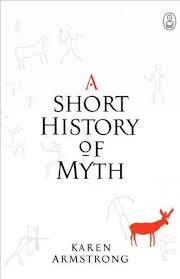
One of my favorite pieces of reading has been Karen Armstrong’s book A Short History of Myth, which traces the evolution of mythology from the Paleolithic period to the present day. In considering the place of mythology in our world Armstrong writes that “The imagination is the faculty that produces religion and mythology…the imagination is also the faculty that has enabled scientists to bring new knowledge to light.” She also points out that “…like science and technology, mythology…is not about opting out of this world but about enabling us to live more intensely within it.”

MCResearchThat intensity is evident in nearly all of the individual stories and beliefs we discovered and is one of the reasons they have been retold and appropriated over and over; by poets, by scholars and by writers of literature for all ages. I am personally very interested in how fairy stories have been rewritten by authors of young adult and children’s literature and one of the pleasures of this research process for me is that it has given me an excuse to re-read some old favorite children’s books that incorporate British and Celtic myth. If you are interested in British folklore but maybe don’t feel like getting into the heavy academic side of things, I recommend these titles as both fun and worthwhile.

The Weirdstone of Brisingamen by Alan Garner

The Dark is Rising (series) by Susan Cooper

The Moorchild by Eloise Jarvis McGraw

The Hounds of the Morrigan by Pat O’Shea

Sneak Peek: Malevolent Creature Designs

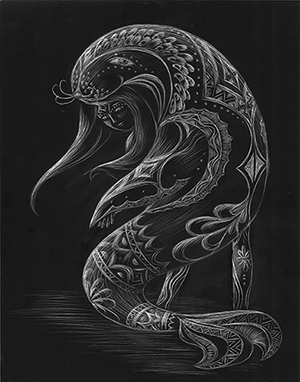
In a few weeks we’ll gather a team of performers to start creating material for our show Malevolent Creatures. But the process of designing the puppets has already started, beginning with research on British folklore and the selection of a cast of supernatural creatures. We gave descriptions of those creatures to artists from across the US and asked them to create images to inspire our puppet-building. Here is a sneak peek at two of them. Both were created by former students at the Maryland Institute College of Art (MICA). The Selkie (a seal that can transform into a human) was created with scratchboard technique by Jordis Brier, an artist originally from Hamburg, Germany and now living in London. Black Annis, a cannibal witch with connections to nature spirits and goddesses, was created in watercolor by Amelia Gossman, from Maryland. We are incredibly excited to turn these images into puppets and we hope you enjoy this beautiful, imaginative art!

Selkie, artwork by Jordis Brier

Selkie, artwork by Jordis Brier

Black Annis, artwork by Amelia Gossman

Black Annis, artwork by Amelia Gossman

April Grab Bag

A round-up of articles and events we’ve highlighted on Twitter this month. 

Sleeping Beauty in performance. Photo by Gene Carl Feldman.

Sleeping Beauty in performance. Photo by Gene Carl Feldman.

1. Pointless Theatre’s production of Sleeping Beauty: a puppet ballet has only one more weekend to run! You’ll be sorry if you miss it.

2. Elizabeth Hyde Stevens wrote this article for Salon about the Muppets and how they created Generation X.

3. A group of Argentine puppeteers is seeking participants for a convention of women puppeteers from around the world, to be held in Argentina this coming November. Stated goals for the convention include discussion about the messages of shows, the space we occupy, who we reach with our art and how we can help each other. If you are interested in participating or simply learning more, you can email convenciondetitiriteras@gmail.com

4. Poncili Creacion was in town for one night this month. Find out more about the work of this Puerto Rican theater company that creates surreal puppetry on their tumblr.

5. We were fortunate enough to see Ronnie Burkett’s amazing marionette show Penny Plain at the Kennedy Center (more of our thoughts here). For those interested in learning more about Burkett’s work, here’s an old interview from The Guardian.

6. Our favorite illustrator and key inspiration Shaun Tan has a new book out! It’s called Rules of Summer, read more about it on his website here.

Our Folklore Project has a NAME!

Names, as anyone familiar with myth and supernatural creatures will tell you, have great power. So we are beyond excited to be able to announce the name of our next devised theater piece:

MC-title-DKNorthumbria

Selkie, artwork by Jordis Brier

Selkie, artwork by Jordis Brier

Inspired by traditional fairy beliefs of the British Isles, we are creating puppets of various malevolent creatures based on designs by artists from across the US and beyond. We will be inviting audiences to interact with supernatural creatures of legend and mythology in the spirit of a choose-your-own-adventure book.

Follow this blog (or Facebook and Twitter) for more updates and mark your calendars for our work-in-progress showing on June 26 & 27 at GALA Hispanic Theatre!

A Few Puppeteers You May Not Know

So yes, technically March was Women’s History Month and now it is April. Too bad, we’re still going to highlight three women puppeteers from around the world that you may not have heard of before. These women worked in very different forms of puppetry but each was a trailblazer in her own way.

Hand Puppet by Lola Cueto from the International Puppetry Museum.

Hand Puppet by Lola Cueto from the International Puppetry Museum.

You’ve probably heard of the painter Frida Kahlo, but a less familiar artist from the same era is Maria Dolores Velasquez Rivas (1897-1978), better known as Lola Cueto. She studied at the Academy of San Carlos along with the muralist David Alfaro Siquieros but her education was interrupted by the Mexican Revolution. She eventually became one of the few prominent women artists in Mexico at the time, taking her inspiration from Mexican folk art such as ‘papel picado’ and wooden children’s toys. Cueto lived in Paris from 1927-1932 where she first began creating hand puppets. After returning to Mexico, she founded several different puppet companies that performed educational shows for children. Cueto’s work can be seen in the Museum of Modern Art in Mexico City, the Brooklyn Museum and various puppetry collections.

This may surprise fans of Snow White, but Walt Disney was not the first person to create a full-length animated film. So far as we know, that was Lotte Reiniger, a German silhouette artist and puppeteer who created The Adventures of Prince Achmed in 1926. Born in Berlin in 1899, Reiniger combined her love of Chinese shadow puppetry and film into groundbreaking animated shorts and eventually feature length films that showcase her detailed shadow cutouts. She began by creating silhouettes for title cards and short sequences in live-action films and then gradually progressed to creating her own full-length work. Reiniger and her husband continued to create films even as they moved around Europe during World War II, eventually settling in England, where she died in 1981. You can see footage of Reiniger’s work, as well as an interview with her and a sequence she inspired in one of the Harry Potter films here. Below is her absolutely delightful short about Papageno, from Mozart’s opera The Magic Flute. 

Cueto created hand puppets and Reiniger silhouettes; now we turn to marionettes and Gretl Aicher, the artistic director of the Salzburg Marionette Theater from 1977 until her death in 2012. Aicher inherited the theater from her father Hermann, who in turn had taken over from his father Anton. Trained as a sculptor, Anton Aicher founded the theater in 1913, so Salzburg has been enjoying these marvelous performances for a century. Today the Salzburg Marionette Theater employs a staff of 12 puppeteers and over 500 puppets, and performs operas, ballets and children’s plays both in Salzburg and all over the world. Under the leadership of Aicher, they have collaborated with the Salzburg Festival, as well as various international festivals. When asked in a 2004 book about the theater why ‘a life with marionettes,’ Aicher replied “For me, it is the process of empathizing with mind and soul, of feeling at one with the music and movement that bring these much-loved creatures to life.” Cueto and Reiniger would probably agree.