June Grab Bag

A roundup of articles, videos and more that we highlighted on Twitter this month. 

A new book from Ashley Bryan. See #3.

A new book from Ashley Bryan.     See #2.

1. Paul McCartney. And a robot puppet. Dancing together in this video. Need I say more?

2. Children’s author Ashley Bryan makes puppets from found objects washed up on the beach near his home on Little Cranberry Island, Maine. Read this interview from Publisher’s Weekly about his new book of puppets coming out this summer.

3. ADORABLE tabletop puppetry is featured in the production Moominsummer Madness from Polka Theatre in London. Based on the stories of legendary author Tove Jansson, you should definitely check this out if you are in the UK.

4. A gallery of Drabbits from the fabulous Imaginarium Galleries in Pennsylvania.

5. I think it’s safe to say that Julie Taymor’s work on Disney’s The Lion King was the first glimpse many people had of non-Sesame Street puppets. It’s coming back to the Kennedy Center this summer.

Not-So-Malevolent Rehearsals

Since we are devising this show rather than working from an existing script, rehearsals are a mix of discussion, improvisation and lots and lots of laughter.  A reminder that our work-in-progress showings are June 26/27 at 7pm at GALA Hispanic Theatre! Tickets are free and you can reserve your spot here. A few photos of the team in action:

IMG_1811

Improvising a set with items in the room.

Carol reacts to a rehearsal puppet.

Carol reacts to a rehearsal puppet.

Sometimes you think better when everyone is on the floor.

Sometimes you think better when everyone is on the floor.

Rehearsal puppet in pieces.

Rehearsal puppet in pieces.

Rehearsal puppet put together and strung on a control!

Rehearsal puppet put together and strung on a control!

A Quick Guide to Puppets

Curious about puppets? Looking for some basic information about how to tell what kind of a puppet you might be looking at? You’ve come to the right place. Puppets are quickly gaining exposure in our popular culture, but they belong to a very old tradition, and are just as diverse as many other art forms. Here are some basics to know:

The definition of ‘puppet’ can be slightly different depending on who you talk to. Most people picture the fabric toy puppets they might have had as children, or the Muppet characters created by Jim Henson for Sesame Street. We often say that a puppet is any object brought to life by an operator, a definition which includes both realistic and abstract characters.

A hand puppet created by a student.

A hand puppet created by a student.

Hand puppets are puppets operated by the puppeteers hand inside the puppet’s body, usually making the head and hands move. Punch and Judy are good examples of traditional hand puppets. Sometimes a hand puppet is operated by two people, such as Telly Monster from Sesame Street.

Rod puppets are puppets with a rod holding up the body and usually two rods controlling the hands or arms. This allows the puppeteer to put some distance between themselves and the puppet. They are traditionally found in southeast Asia, primarily Indonesia.

Czech style marionette.

Czech style marionette.

Marionettes are puppets controlled by strings or wires. A good example of marionettes are the puppets in the movie The Sound of Music. Some marionettes can have up to a dozen strings controlling all the different parts of the body. Marionettes are usually human figures but can also be animals or abstract figures.

Over-life-size puppets is the term used by puppet historian John Bell to describe puppets that are larger than human size or enclose the puppeteer inside the puppet. Big Bird, from Sesame Street is an example of this kind of puppet.

Shadow puppets that we created for Fabulas Mayas at GALA Hispanic Theatre.

Shadow puppets that we created for Fabulas Mayas at GALA Hispanic Theatre.

Shadow puppets are flat cutout figures traditionally seen in silhouette, behind a screen. They can be made of paper, plastic, or leather and are sometimes opaque and sometimes translucent.

Object puppet is a term we sometimes use to describe characters that are created from found objects. All puppets can be classified as ‘object theater’ but these are characters made from a single object such as a hairbrush, fork or pair of binoculars.

Bunraku is a style of puppet originally from Japan. They are usually half or three quarters of human size and are operated by three puppeteers at once.

May Grab Bag

A roundup of articles and more that we highlighted on Twitter this month

Czech style marionette carved by Cecilia in one of Mirek's classes.

Czech style marionette carved by Cecilia in one of Mirek’s classes. See #1

1. A great article with even more awesome photos about our friend Mirek Trejtnar who runs the Puppets in Prague marionette-building workshops. Read it if you’ve ever been curious about how to make a marionette.

2. Some advice from Jim Henson, rendered in brilliant comic form by Gavin Aung Than. Read it for inspiration–we keep it handy in the studio for when motivation is needed!

3. Genna discovered this article about an artist performing with puppets in the New York subway. I don’t think I’ve ever seen anyone perform with a puppet in the DC metro–have you?

4. An article and video from Sandglass Theater of Vermont about their recent experiences performing in Cuba. Their work is a huge inspiration to us and well worth a look.

5. NPR has a weekly podcast called Pop Culture Happy Hour and recently one of the discussion topics was fairy tales. It’s not exactly the kind of stories we’re working with for Malevolent Creatures but still interesting and fun to listen to.

Malevolent Creatures Research

mythThere have been two main categories of research for Malevolent Creatures. First is the folklore itself: stories, traditions, rituals and beliefs from the British Isles that center around fairies and other supernatural creatures. The second is how those beliefs fit together, how they have changed over the years and the various theories about where they came from and the meanings behind them.

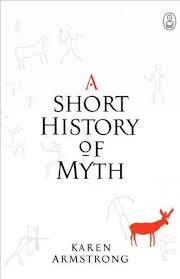
One of my favorite pieces of reading has been Karen Armstrong’s book A Short History of Myth, which traces the evolution of mythology from the Paleolithic period to the present day. In considering the place of mythology in our world Armstrong writes that “The imagination is the faculty that produces religion and mythology…the imagination is also the faculty that has enabled scientists to bring new knowledge to light.” She also points out that “…like science and technology, mythology…is not about opting out of this world but about enabling us to live more intensely within it.”

MCResearchThat intensity is evident in nearly all of the individual stories and beliefs we discovered and is one of the reasons they have been retold and appropriated over and over; by poets, by scholars and by writers of literature for all ages. I am personally very interested in how fairy stories have been rewritten by authors of young adult and children’s literature and one of the pleasures of this research process for me is that it has given me an excuse to re-read some old favorite children’s books that incorporate British and Celtic myth. If you are interested in British folklore but maybe don’t feel like getting into the heavy academic side of things, I recommend these titles as both fun and worthwhile.

The Weirdstone of Brisingamen by Alan Garner

The Dark is Rising (series) by Susan Cooper

The Moorchild by Eloise Jarvis McGraw

The Hounds of the Morrigan by Pat O’Shea

Puppet Reality TV

syfyI finally found the time to sit down and watch the first episode of Jim Henson’s Creature Shop Challenge online. Here are some thoughts:

The format seems pretty standard for a reality show. The ten contestants are given a challenge and put in teams, they have two days to design and build the creature; then there is a screen test after which they explain a little bit about their work. The panel of three judges gives feedback, selects one winner and sends one contestant home. Because this was the pilot episode, most of the talking heads and short interviews focused on the contestant’s backgrounds, contrasting those who were freelancers with those who worked for established studios, people who were used to fancy tools and materials vs. those who usually built with tinfoil and hot glue. There wasn’t always the greatest balance between a focus on the working relationships of the teams vs. a focus on the challenge in the work itself.

My favorite parts were the clips of the teams working in the studio (except when there would be these strange little freeze frames that happened every couple of minutes, which were annoying) and the discussion among the judges after the screen tests. While the clips of in progress work were fairly brief, they did give a sense of the tools and materials used and I’m guessing that later episodes get more complicated with the use of cables and animatronics, etc. Overall, I don’t think I’m the best audience for this show, just because I’m not a huge fan of the format. Competition stresses me out and I’m much more interested in the working process than the tensions between teammates. However, for someone interested in a behind the scenes glimpse of how fantastic creatures are created for television and movies, this is a worthwhile show to check out.

Sneak Peek: Malevolent Creature Designs

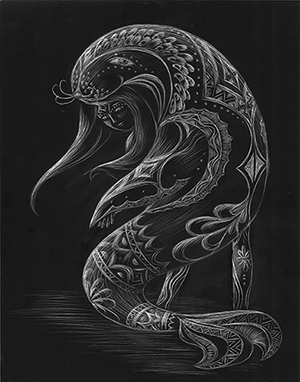
In a few weeks we’ll gather a team of performers to start creating material for our show Malevolent Creatures. But the process of designing the puppets has already started, beginning with research on British folklore and the selection of a cast of supernatural creatures. We gave descriptions of those creatures to artists from across the US and asked them to create images to inspire our puppet-building. Here is a sneak peek at two of them. Both were created by former students at the Maryland Institute College of Art (MICA). The Selkie (a seal that can transform into a human) was created with scratchboard technique by Jordis Brier, an artist originally from Hamburg, Germany and now living in London. Black Annis, a cannibal witch with connections to nature spirits and goddesses, was created in watercolor by Amelia Gossman, from Maryland. We are incredibly excited to turn these images into puppets and we hope you enjoy this beautiful, imaginative art!

Selkie, artwork by Jordis Brier

Selkie, artwork by Jordis Brier

Black Annis, artwork by Amelia Gossman

Black Annis, artwork by Amelia Gossman

Recent Workshops

IMG_1653In the past month, we’ve had several different workshops in DC and Virginia, teaching students ages 4-16 to design, build and perform their own puppets. Here are some pictures of what they created. As always, if you are interested in learning more about our workshops or bringing us to your school, check out our Education page.

The photo to the left was taken at the American Immigration Council’s Take Your Child to Work Day event. The puppets below were created in a workshop with the 2nd and 3rd grades at Tuckahoe Elementary School in Arlington, Virginia.

This slideshow requires JavaScript.

April Grab Bag

A round-up of articles and events we’ve highlighted on Twitter this month. 

Sleeping Beauty in performance. Photo by Gene Carl Feldman.

Sleeping Beauty in performance. Photo by Gene Carl Feldman.

1. Pointless Theatre’s production of Sleeping Beauty: a puppet ballet has only one more weekend to run! You’ll be sorry if you miss it.

2. Elizabeth Hyde Stevens wrote this article for Salon about the Muppets and how they created Generation X.

3. A group of Argentine puppeteers is seeking participants for a convention of women puppeteers from around the world, to be held in Argentina this coming November. Stated goals for the convention include discussion about the messages of shows, the space we occupy, who we reach with our art and how we can help each other. If you are interested in participating or simply learning more, you can email convenciondetitiriteras@gmail.com

4. Poncili Creacion was in town for one night this month. Find out more about the work of this Puerto Rican theater company that creates surreal puppetry on their tumblr.

5. We were fortunate enough to see Ronnie Burkett’s amazing marionette show Penny Plain at the Kennedy Center (more of our thoughts here). For those interested in learning more about Burkett’s work, here’s an old interview from The Guardian.

6. Our favorite illustrator and key inspiration Shaun Tan has a new book out! It’s called Rules of Summer, read more about it on his website here.

Our Folklore Project has a NAME!

Names, as anyone familiar with myth and supernatural creatures will tell you, have great power. So we are beyond excited to be able to announce the name of our next devised theater piece:

MC-title-DKNorthumbria

Selkie, artwork by Jordis Brier

Selkie, artwork by Jordis Brier

Inspired by traditional fairy beliefs of the British Isles, we are creating puppets of various malevolent creatures based on designs by artists from across the US and beyond. We will be inviting audiences to interact with supernatural creatures of legend and mythology in the spirit of a choose-your-own-adventure book.

Follow this blog (or Facebook and Twitter) for more updates and mark your calendars for our work-in-progress showing on June 26 & 27 at GALA Hispanic Theatre!