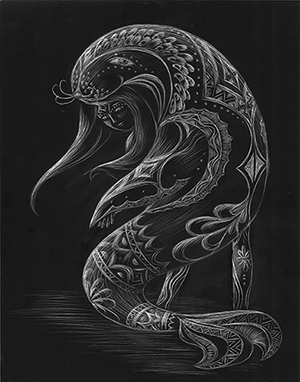
Wit’s End artistic director Cecilia Cackley is currently traveling in South America. While she is gone, Cecilia is keeping a visual journal of the places she visits and shows that she sees. She will be posting pages here occasionally as virtual postcards from her trip.
Category Archives: Performances
Workshop Photos
We had a fantastic two showings of Malevolent Creatures a few weeks ago. If you were unable to join us, here are some photos of the puppets and the process. Check back soon for more information about the next development stage of this show!
Our Folklore Project has a NAME!
Names, as anyone familiar with myth and supernatural creatures will tell you, have great power. So we are beyond excited to be able to announce the name of our next devised theater piece:
Inspired by traditional fairy beliefs of the British Isles, we are creating puppets of various malevolent creatures based on designs by artists from across the US and beyond. We will be inviting audiences to interact with supernatural creatures of legend and mythology in the spirit of a choose-your-own-adventure book.
Follow this blog (or Facebook and Twitter) for more updates and mark your calendars for our work-in-progress showing on June 26 & 27 at GALA Hispanic Theatre!
Building a Puppet Ballet: Interview with Genna Davidson
This week, our managing director Patricia Germann spoke with Wit’s End artist Genna Davidson about her recent work constructing puppets for Pointless Theatre Company’s newest show, Sleeping Beauty: A Puppet Ballet, which is currently running as part of CulturalDC’s Mead Theatre Lab program.
Patricia Germann: What puppets did you work on?
Genna Davidson: I primarily worked on Sleeping Beauty, the Prince, and the Witch who turns into a dragon. I worked on all of them, actually, but those are the primary ones.
PG: I recall that Pointless did a version of Sleeping Beauty before. Did they learn lessons from the last production, in terms of how they wanted them to move, or how they wanted them to be built?
GD: They needed the puppets to be way lighter. Because for the first production of the show they had made them all out of papier-mâché and wood; they were super heavy. They also wanted the puppets to have a lot of flexibility – but not limitless flexibility, because that makes them hard to control. So I contributed the bodies, the structures, the new innards and forms of the puppets focusing on building with lighter materials.
PG: You had told me before that the company went to ballet classes. Did that experience affect how you were building the puppets, or modifying them during the rehearsal process?
GD: One thing we learned is that these puppets – because it’s ballet – they stand mostly in turnout. When I made the Prince, I made his legs with feet and knees pointed forward. At some point, we realized this means the puppeteer has to always be turning the feet out. It would be much easier to just have them built in turnout, and then the puppeteer can turn them in as needed, which is almost never. So I adjusted them on the Prince, and then when I made Sleeping Beauty, I made her legs in turnout.
PG: Were the puppets pretty durable? I’m thinking back to our own experiences with having to repair puppets over a run.
GD: From every project that we do, I learn more and more. I’ve been very happy with some of the joints of these puppets, in particular the ones which I chose to make elastic from the get-go because of wanting to allow the puppeteers to extend through the ballet movements and then settle back; more breath. So at important junctures, they have thick fabric-covered elastic joints.
Their spines are really cool. They’re made out of dishwasher drainer hose, which is connected to PVC with hose clamps and plumbing parts. So there’s lots of plumbing inside! The drainer hose allows for lots of flexibility, so that the spine can actually arch backwards and forwards.
I had to rig the head in such a way to allow for rotation to the right and left independent of the neck which can only get easy movement arching forward and backward. Imagine a wooden dowel coming out of the bottom of the head and inserting within a hollow cylinder, the spine. The heads can spin 360 degrees, but the reason that the head is staying inside of…or one part of the neck is staying inside the other part of the neck…is that I ran a piece of elastic along the outside of the spine all the way underneath the pelvis of the puppet and back up again to that dowel coming out of the head. And that has been – knock on wood – really pretty durable.
PG: We haven’t really talked about the witch-to-dragon transformation.
GD: Basically you have to see it to understand it and I don’t want to give it away.
PG: Did they have a design for that going in, or did you come up with that transformation?
GD: No, I came up with the design.
PG: Wow, that’s really cool.
GD: Yeah, that one in particular was my feat of magic – but I wish we had had more time to rehearse the transformation. It took me so long to construct that we were basically in tech and didn’t have long to choreograph it. [The transformation] works well, but I would have liked to suggest some other choreographed movement. For a couple days, we were worried we’d have to cut the transformation onstage and leave it to happen offstage, which would have been really disappointing.
The one thing we couldn’t make happen was her face turning into a dragon. We ended up just bringing on this mask and putting it on her face, basically. It’s done in a way that works, but we had wanted to have the mask incorporated somehow into her as a witch, so that when the transformation happens, it would be like, “Oh, it was there the whole time!” That was something we had to let go.
I do want to mention Kyra Corradin, who did the sculpting of all the heads. Even the puppets who were primarily mine in body, she did those heads, and they’re really beautiful.
PG: You were telling me earlier about the challenges of trying to fit a controller into a head that was already built.
GD: Kyra had built these heads and made them hollow because it would make them lighter…but because she has built these kinds of puppets before, she didn’t think about how to build the head control mechanisms into the puppets. But actually it worked out well because these heads are really well shaped, beautiful and completely hollow. Though it was tricky to get the mechanisms inside and not damage the sculptural work, it was worth it. If we had had to build the head around the control mechanism, I’m not sure we would have been able to achieve that hollow, light head that she created. So not knowing is a benefit sometimes.
Pointless Theatre Company’s Sleeping Beauty: A Puppet Ballet runs through May 3, 2014, at the Mead Theatre Lab at Flashpoint. For tickets and more information, visit www.culturaldc.org.
This interview was edited for length and clarity.
A Midsummer Night’s Dream & Penny Plain
Both of these shows were presented as part of the Kennedy Center’s World Stages Festival in March 2014.
A Midsummer Night’s Dream, Bristol Old Vic with puppets by Handspring Puppet Company.
Perhaps as a result of their collaboration with Handspring, Bristol Old Vic presented a version of Dream that connected the characters and their story to objects, humble materials and craftsmanship. The set was an immediate hint that this was not going to be your usual, run-of-the-mill Shakespeare production. Ladders, stools, lattice and paint drops gave the feeling of being in a workshop, and one actor wandered about onstage handling wood and tools with ease.The costumes were rough work clothes, with few differences between the mechanicals and the nobles, while the actors playing Oberon and Titania carried large sculpted masks and in Oberon’s case an oversized jointed hand. The mechanicals used large blocks of wood as props in their rehearsal, which by the final performance of Pyramus and Thisbe had been carved into rough representations of the doomed lovers. Even the woods of Athens were displayed literally–the actors held up planks of wood for the lovers to hide behind and travel through during their scenes.
In keeping with the rough aesthetic, the puppets used for Puck and the other fairies were somewhat motley in style and appearance. Puck was played by three of the mechanicals, each holding a different object (mallet, fork, metal can, etc) that they brought together to form the head, body and appendages of the character. The exact setup might be different each time, but the hobgoblin could move like lightning simply by having all the objects zoom off in different directions, which was very effective whenever Oberon called for his servant. Peaseblossm and company were slightly more grotesque, with exaggerated features and only one or two body parts made from objects similar to Puck. Bottom’s transformation, like the woods of Athens, took Shakespeare’s text quite literally, with an over-the-top visual gag that the actor pulled off with aplomb. The transformation mechanism, along with fully realized versions of Oberon and Titania used in the final dance, were the only puppets that seemed to be created in a woven cane style similar to the War Horse puppets.
There was one small mystery: in the publicity photos for the show, the lovers each had a small puppet of themselves. Onstage, these were nowhere to be seen. I didn’t miss them; it made sense that puppetry was used for the otherworldly characters, with rough imitations by the mechanicals as part of their own play within the play. The large masks and hands made Oberon and Titania larger than life, while Puck’s transformative qualities were superbly created (and recreated) by his collection of objects. This production of Dream brought the audience fully into the darkness and strangeness of the woods and the fairies’ world.
Penny Plain, Ronnie Burkett Theatre of Marionettes.
In the Terrace Theater, a smaller scale, yet arguably more epic story was on display in Penny Plain, an original show by Ronnie Burkett from Canada. Set in a future world that is disintegrating fast, the story centers on Penny Plain, an old woman in a boarding house full of odd characters who has only her dog for company. But Geoffrey has decided that he wants to be a man, not a dog and at the beginning of the play heads out into the world, leaving Penny by herself. As news clips are heard that detail the food and money shortages, the environmental disasters and the desperation of humanity, Penny and the rest of the people in the house try their best to survive.
Burkett performed Penny Plain, solo, controlling over 20 marionettes alone or in pairs, around the two levels of the set that depicted the boarding house. Some characters had two different puppets, one to appear on the upper floor and one with longer strings to appear on the lower. The style of both the writing and the puppets was naturalistic, with brilliant touches of the macabre. Burkett switched voices expertly throughout the rapid-fire dialogue, punctuated by heavy pauses. The themes of change, human nature and survival are heavy, but satire helped to undercut the serious tone (a scene with two US refugees from the south was especially delicious). Burkett built the tension in the story expertly, alternating gruesomely funny sequences with poignant conversations until the entire audience was riveted. Directly after the final blackout, I heard someone behind me heave a sigh of relief, as though being released from a magic spell. This show was a brilliant example of the power of pure puppetry.
-Cecilia Cackley
INTERSECTIONS: An Artist’s Perspective
Life has been a little overwhelming of late, so it’s taken me a few weeks to be able to sit down and collect my thoughts about this year’s INTERSECTIONS festival. Performing there was a fantastic experience and I want to take the time to share a little of what made it such a special event.
Artists, even when working in groups such as orchestras, or dance and theater companies, can feel isolated. It is one of the ironies of being a working artist that you are often too busy with your own projects to have the time (and money) to see other people’s work. To that end, one of the best things about INTERSECTIONS is that it brings all the artists together in one building. Walking around before and after our show, you could hear snippets of music coming from different theaters, classical mixing with jazz mixing with flamenco. In the lobby between shows you could pick out dancers and musicians talking with audience members, everyone making space for the small children running around with their families. The free cafe concerts in the lobby and art activities for children made the space a welcoming one for audiences of all ages and fans of all kinds of art.
INTERSECTIONS takes place at the Atlas Performing Arts Center on H St. NE and all the staff there worked incredibly hard to make us feel welcome and to encourage us to support each other’s work. While each performance was assigned one of the four ‘roadmaps’ (Sound, Movement, Story or Family) everyone was very enthusiastic and interested to hear about what was going on in other roadmaps and other theater spaces. Meetings, parties, and off site events were opportunities to make connections and learn about music, dance and other arts traditions that were unfamiliar. Serendipitous moments abounded (possibly my favorite was listening to Victoria Vox and Christylez Bacon improvising music together).
My one regret was that due to my crowded schedule, I was not able to see more performances by my fellow artists. A huge thank you to festival director Mary Hall Surface, and everyone at Atlas for making this such a wonderful experience. I hope to be back again another year!
Intersections Photos
Performing at the 2014 Atlas INTERSECTIONS Festival was an absolutely incredible experience. I’m hoping to write more fully about it soon, but in the meantime, here are some photos I took over the past two weekends.
Sneak Peek
Our next devised piece is inspired by the vast treasure trove of British and Celtic folklore and especially the supernatural creatures usually known as fairies. Thanks to a number of cultural factors (most prominently, Disney), we have a tendency to think of fairies as tiny and pretty, with sparkles, wings and magic wands. According to tradition however, they are far stranger and more dangerous. For centuries, people feared the fairies, calling them a number of euphemistic names (the Good Folk, the gentry, the Little Poeple) to avoid drawing their attention. To be suspected of dealing with fairies or being related to them led to persecution and on occasion, injury and death. Where did these beliefs come from? What are the rules for dealing with fairies and what happens when we break them? What does that say about our fears, hopes and wishes as humans? These are all questions we will be exploring as we begin to build puppets and create performance material in preparation for a workshop in June. We hope you will join us for the journey!
Announcing INTERSECTIONS 2014!
We are thrilled to announce that BOTH our collaborative projects this year will be presented as part of the Atlas INTERSECTIONS Festival 2014!
Under the Canopy by Arts on the Horizon and Fabulas Mayas, co-produced with GALA Hispanic Theatre will each have multiple performances as part of the fifth year of INTERSECTIONS. This festival seeks to connect the broadest possible audience with the most exciting new ways of making community-inspiring art. With performances for all ages and audiences, from music to dance to circus to storytelling and new plays, there is truly something for everyone. Tickets go on sale January 9, so we hope you will join us at Atlas Performing Arts Center on H St. NE from February 21-March 8 to see our shows and some of the other amazing work at the festival. As we get closer, we will have more information here or you can also check out the festival website.
Library Connections for Fabulas Mayas
I wrote the show Fabulas Mayas because I wanted to share some of the rich oral traditions among the Maya people of Mexico and Central America. While these stories are nowhere near as widespread and familiar as European folktales, they often follow similar patterns and are humorous and entertaining. Most of our work at Wit’s End Puppets is inspired by stories and artists that you can find easily at any library or bookstore. If you saw Fabulas Mayas and are interested in learning more, or if you just like stories and sharing them, here are some resources to look for at the DC Public Library.
Source for some of the stories of Fabulas Mayas:
The Monkey’s Haircut and other stories told by the Maya by John Bierhorst
Other Latin-American stories and story collections:
People of Corn by Mary-Joan Gerson
Tales our Abuelitas Told by F. Isabel Campoy & Alma Flor Ada
The Hungry Woman: myths and legends of the Aztecs by John Bierhorst
Señor Cat’s Romance by Lucia Gonzalez
Just a Minute by Yuyi Morales
Once Upon a Time/Habia una vez by Reuben Martinez