Meet Puppeteer Genna Davidson

Third in our series of short interviews with the cast of The Amazing and Marvelous Cabinets of Kismet. All photos are by Sarah Gingold. 

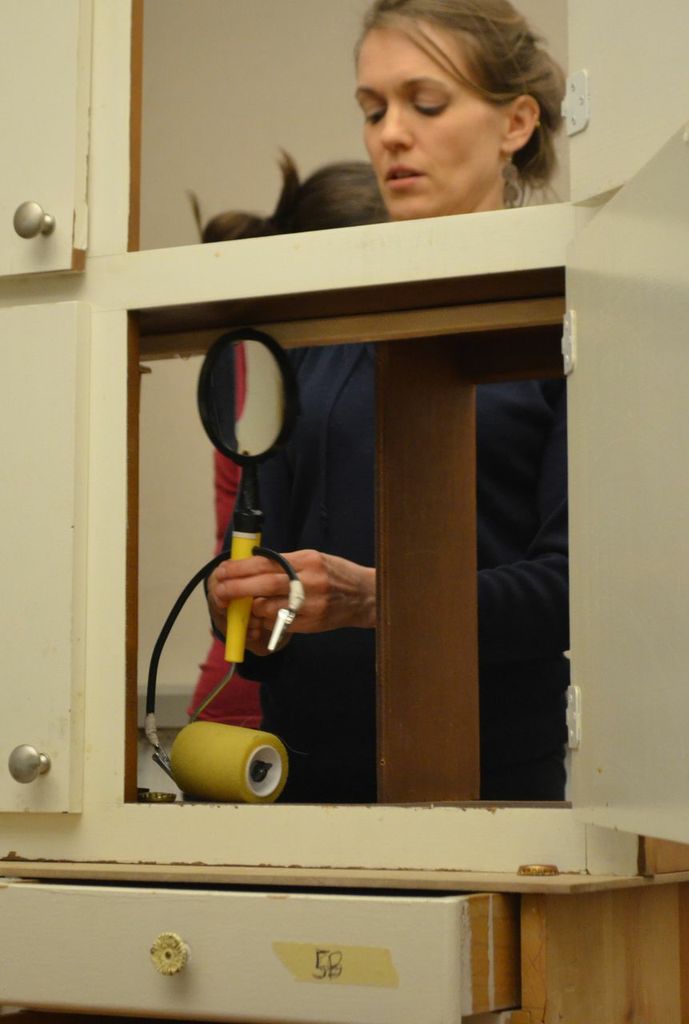
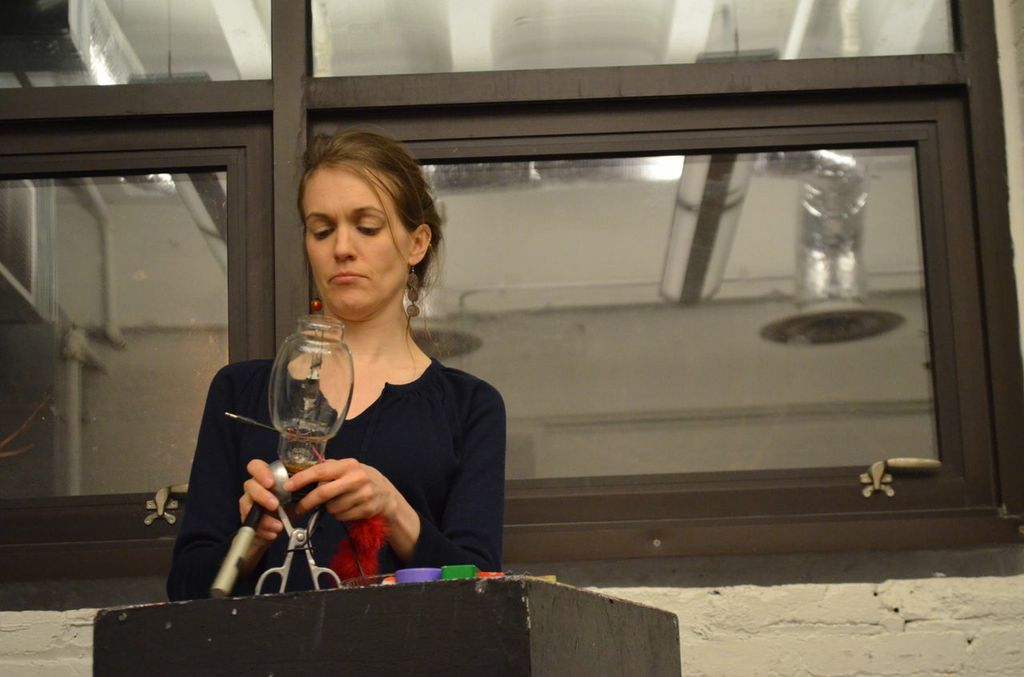
Genna with King Lamp and Swirl Dancer.

Genna with King Lamp and Swirl Dancer.

Bio: Genna Davidson is a Washington DC based actress, puppeteer and musician. She graduated from the University of Maryland, College Park in 2008 with a BA in Theatre. In addition to Wit’s End Puppets, she has performed with The Hub Theatre, dog & pony dc, Deviated Theatre, The Bay Theatre Company, as well as workshop productions with the Rude Mechanicals (Austin, TX), 500clown (Chicago) and various local devised-theatre ensembles.

When did you first start working with puppets?

I was nineteen, in college at the University of Maryland. There was a show being done with Bunraku style puppets and they knew no one would have any experience so they held an audition and taught us what to do. It was a very in-depth process, which was nice.

Genna with Nurse and Kismet.

Genna with Nurse and Kismet.

What is the most unusual puppet or puppet show you’ve worked on?

This one! Actually, in high school I didn’t realize it, but I did a puppetry production of Flatland with my best friend at the time. We had to turn a  book into an interactive presentation and we had wanted to just release a bunch of butterflies (for A Hundred Years of Solitude) but butterflies were too expensive so we did Flatland instead with cardboard and a basketball. Looking back I realize that they were actually puppets.

Which puppet is your favorite to perform in Cabinets of Kismet? 

King Lamp, because I think he’s challenging and I just love the fact that he thinks he’s a king and therefore he is. But he really doesn’t have power over any other puppet. He gets to hitch a ride on another puppet.  And he can do cartwheels!

Meet Puppeteer Amy Kellett

Second in our series of short interviews with the cast of The Amazing and Marvelous Cabinets of Kismet. All photos by Sarah Gingold. 

amy2

Amy operating the paper puppet Frank.

Bio: Amy is delighted to be puppeteering with Wit’s End Puppets in this production! Some of the other companies/festivals she has performed with as a puppeteer or human in the MD/DC area include The Puppet Co., Source Festival, Landless Theater, Madcap Players and Bay Theatre Company.

When did you first become interested in puppetry?

I don’t know…I guess the first time I really thought about performing puppets was when I auditioned for The Puppet Co. in Glen Echo, MD. It was a big learning experience and my first interaction with people who were professional puppeteers and knew how to build cool things.

amy1

Amy and Kismet.

Probably this one. Most of the other stuff I’ve done has been more straightforward. This is the first devised puppet show I’ve ever worked on; other shows have been already written before we started. This is also the first time I’ve ever worked with found object puppets in a show.

Which is your favorite puppet to perform in Cabinets of Kismet? 

Bully is my favorite because he can do lots of things with his arms, which are magnets. He can pick up and hold lots of things, which I find useful. He’s also fairly mobile, so he can move lots of places.

Meet Puppeteer Heather Carter

The first in a series of short interviews with the cast of The Amazing and Marvelous Cabinets of Kismet. All photos are by Sarah Gingold

heather1

Heather and Kismet.

Bio: Born helpless, nude and unable to provide for herself, Heather Carter eventually learned to overcome two of those three problems. Preferring to refer to herself not only in the third person but also as a ‘theater-maker’ she works on developing a type of theater that is holistically informed: that is, everybody does everything. A puppet maker, physical theater performer and erstwhile lighting designer and electrician, she loves the spectacle of theater and introducing the improbably and imaginative into Everyday LIfe. Formal training includes: The Center for Movement Theater (DC), Sandglass Puppetry Institute (VT), Commedia Dell-Arte with Antonio Fava (Reggio Emilia, Italy), Shakespeare and Co. (MA), Yale School of Drama (CT) and Marlboro College (VT).

When did you first get interested in puppetry? 

Apparently I used to pull the tongue out of a crocheted cow hand-puppet when I was a three year old. Later I went to a college in Vermont where puppetry was a really big deal and I really hated it for my first year and a half there. But then I saw Autumn Portraits, a famous show by my advisor Eric Bass and I finally understood why some stories can only be told by puppets.

heather2

Heather and the Lightbulb puppet.

When I was at the Sandglass Institute for puppet training, one of my first practice ensembles had a puppet that looked like a giant blue sun head, some sort of fabric and a plumb line in it. We spent a huge amount of time trying to figure out when the plumb line should drop out of the head and I still don’t know what that show was about, exactly.

Which is your favorite puppet that you perform in Cabinets of Kismet? 

Kismet! As I discover more about how the puppet is built and his specific movement qualities, he’s become a very sweet, clumsy, myopic and steadfast creature. He has a lot of character and fidelity, who’s the kind of person I would be friends with.

Under the (Artistic) Influence

A shadow box by Joseph Cornell.

A shadow box by Joseph Cornell.

Shaun Tan is clearly our biggest influence in creating The Amazing and Marvelous Cabinets of Kismet. However, now that we have been working on this story and these characters for a year and a half, we are recognizing other artistic influences that have lingered in our minds and imaginations. Here are a few of them:

Joseph Cornell: Mainly an influence on me and Nikki; Genna doesn’t particularly like Cornell. For me though, his boxes evoke cabinets, the building blocks for Kismet’s world. His combinations of paper scraps, photographs and found objects are by turns whimsical, lonely, mysterious and chaotic, all moods that I hope to evoke at one point or another in Cabinets of Kismet. 

One of the dresses that inspired Genna.

One of the dresses that inspired Genna.

Alexander McQueen: When we first started discussing this story and the aesthetic we were hoping to create, everyone brought in art books and catalogues to page through, in hopes of discovering images that would inspire the look or sensibility of a puppet. I had the exhibit catalogue for Alexander McQueen: Savage Beauty lying around and Genna was inspired by several of the outfits pictured. His use of materials such as animal bones and skulls as well as layers of translucent fabric is echoed in a couple of Genna’s puppets use similar treatments. She says she was drawn to McQueen’s work because “…I like the gothic and the macabre. I find darkness to be fascinating.” Look for puppets with those qualities when you come to see Cabinets of Kismet!

Figures by Kandinsky.

Figures by Kandinsky.

Wassily Kandinsky: By the time we started re-thinking Paper World this winter, the look had moved further away from reality and into the realm of the abstract. I started looking at the shapes in paper cutouts by Matisse, but soon focused on the work of Kandinsky. While his work is much more colorful than, well, anything really in Paper World, his lines and shapes have an energy and rhythm to them that I hope to emulate in the shadow puppets that appear and disappear in our show. Keep an eye out for similar creatures when you come see Cabinets of Kismet in April!

February Grab Bag

PUPPET STANDUP! See #3 for all info.

PUPPET STANDUP! See #3 for all info.

1. An interview with Shaun Tan that made me slightly less grumpy that I missed his Keynote Address at the SCBWI Winter Conference earlier in the month. Favorite quote: “…we have to make sense of ourselves within a world that can shift and change radically…” That’s the story of Cabinets of Kismet in a nutshell!

2. Basil Twist, who is one of the most well-known contemporary puppeteers in the US, is creating a lobby installation as part of The Rambler by the Joe Good Performance Group. At the American Dance Institute, March 2 and 3; more info here.

3. Standup is a tough business, particularly when you’re a puppet. THIS Saturday, February 23 at 8 & 10pm, come support local puppets in Puppet Standup, a showcase of the best puppet comics working today. Get tickets here and if you use the code GRABBAG, you’ll get 20% off General Admission tickets to the 10pm show! Don’t miss this unique event (no ventriloquists here!) at the Warehouse Theater, 645 New York Ave, NW.

4. If you’re searching for a fun night out this week or next week, look no further than the Mead Theater Lab at Flashpoint and the show Canterbury, produced by our friends at the Pointless Theatre Company.

5. Our friends at Puppets in Prague still have a few spaces left in their March workshops on making marionettes, for anyone lucky enough to be in Prague this spring.

Shaun Tan & Paul Klee

The Bird KingIn the introduction to his latest book The Bird King, Shaun Tan quotes the artist Paul Klee, who once said something along the lines of “Drawing is taking a line for a walk.” Klee, if you aren’t familiar with his work, was an Swiss painter who lived from 1879-1940, taught at the Bauhaus school, and was part of the Expressionist and Surrealist movements. I love that Tan references him, because Klee was also interested in puppets. Using a rich combination of color and texture, he created a set of hand puppets for his son, many of which can be seen in these excellent photos on Flickr.

Tan also quotes a second Klee metaphor, imagining the artist “…as a tree, drawing from a rich compost of experience–tihngs seen, read, told and dreamt–in order to grow leaves, flowers and fruit. Art, following the laws of horticulture, can only make something out of something else; artist do not create so much as transform.” Both of these quotations strike me as being entirely appropriate to The Amazing and Marvelous Cabinets of Kismet. Many times during this building process, I feel like I have been ‘taking my materials for a walk’–arranging and rearranging and seeing what shapes and characters emerge. So many of these characters have been created without a real design in mind, that it has felt both terrifying and liberating all at once. As a piece of theater, this is very much an example of Klee’s tree; it is art that draws from many different sources in visual art, story and film, and combines them into something new. This is reflected in the hodge-podge of materials we have been using to create our puppets and set, from paper scraps, to bottle caps to empty wooden spools.

Tan comments in the same introduction that he is often “…wary of using the word ‘inspiration’…” and that “…it sounds too much like a sun shower from the heavens, absorbed by a passive individual enjoying an especially receptive moment.” I understand his hesitation, but for me, inspiration is less like a sun shower and more like a flash of lightning or a moment of recognition; something that makes me go YES. That is TRUE. Now DO something with it. Inspiration for me isn’t passive, it is active, a call to act and create. Tan’s books give me that moment of recognition often; so do Klee’s paintings. I feel so fortunate that I get to spend my time turning the inspiration they give me into my own art.

The Simplest Drawing

As we continue creating characters for The Amazing and Marvelous Cabinets of Kismet, much of the process is about simplifying, stripping down and finding the bare minimum of lines and texture that communicate the essence of a character. Here is a quote from fantasy master Terry Pratchett about how even very simple art contains magic.

The White Horse of Uffington in England, which Pratchett often describes in a similar way.

The White Horse of Uffington in England, which Pratchett often describes in a similar way.
CC licensed image via Flickr

“Someone had drawn a tree. It was the simplest drawing of a tree the Bursar had ever seen since he’d been old enough to read books that weren’t mostly pictures, but it was also in some strange way the most accurate. It was simple because something complex had been rolled up small; as if someone had drawn trees, and started with the normal green cloud on a stick, and refined it, and refined it some more, and looked for the little twists in a line that said tree and refined those until there was just one line that said TREE.

And now when you looked at it you could hear the wind in the branches…”

December Grab Bag

A grab bag of various puppet related things that have caught my eye this month:

1. Neil Patrick Harris dreams in puppets.

2. A writer on the website Etsy finds an old Guignol puppet theater in Paris.

3. Our director Carmen found a video of dancers working with paper in a way that is very intriguing. This may not seem to be related to puppets but wait until you see more details on the second half of Kismet and all will make sense.

Ancient Magic

Research books

As you can maybe tell from all the books, I am deep into research for several possible projects, all involving mythology from Ancient Mexico. As I read (and re-read) legends from the Aztec and Mayan civilizations, there is one creation myth that I keep coming back to.

In the Popol Vuh, the oldest documented mythology of the Maya, there is a creation story in which the Heart of Heaven and the plumed serpent Gucumatz try multiple times to create people. On their third attempt they use wood to form men, while women are made of rushes. However because these wooden people lack souls and respect for their creators, the gods decide to destroy them in a flood. So far, this is relatively standard as a creation myth. But the Mayans weren’t content to just drown these early humans. As the story goes, household items such as water jars, tortilla griddles, plates and cooking pots rebelled against the wooden people as well and crushed their faces. Between the rain, the animals and their murderous utensils, there was no place of safety. The story of inanimate objects taking on a life of their own and becoming dangerous figures in other cultures as well and I was intrigued to find this early example from the Americas!