I was lucky enough to take a workshop with shadow puppet artist Gabriel von Fernandez when I was in Argentina back in November. Based in Buenos Aires, Gabriel performs his own shadow puppet shows and teaches workshops to artists at all levels. Here is a page from my journal about my experience working with him.
Tag Archives: puppet building
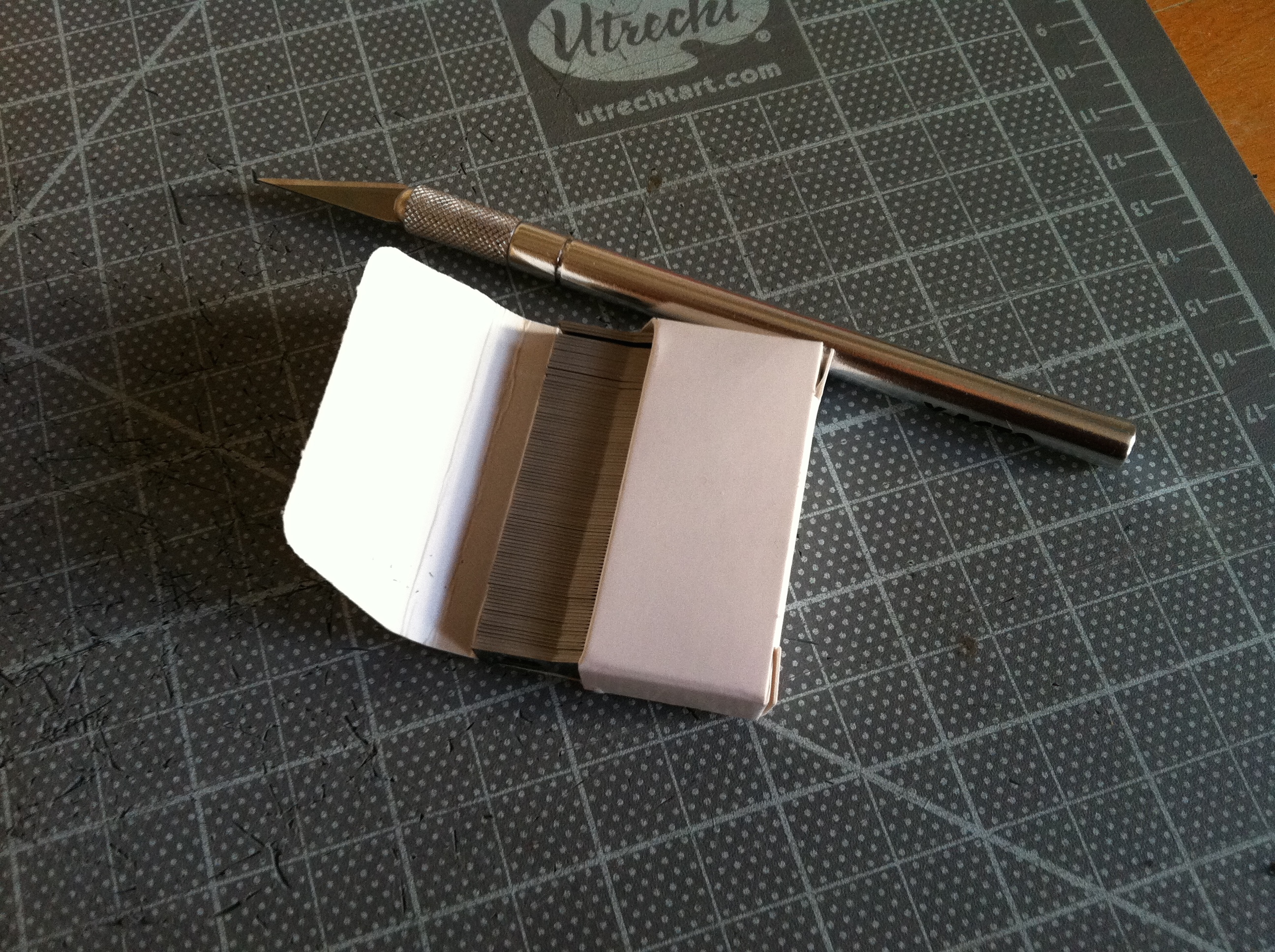
Favorite Tool: X-acto Knife
As we continue to work on building Saudade, my favorite tool has to be this simple X-acto knife and box of blades. When you’re cutting detailed puppets or crankie scenes, a sharp blade is absolutely essential. It’s easy to switch blades quickly with this knife and having a full box of blades means I can pull out a fresh one every few minutes. With shadow puppets, you want every line to be smooth and clean, so it appears as clearly as possible to the audience. This is my favorite tool for making that happen!
You can see Saudade as part of the 2015 Atlas INTERSECTIONS Festival on February 28 at 2:00pm and March 7 at 7:00pm. Performances will be at the Atlas Performing Arts Center on H St. NE. See you there!
Building SAUDADE #2
In shadow puppetry, the light is as important as the puppet. In reality, you are manipulating not the object but the space between the object and the light. Not surprising, then, that we spend a lot of time playing with different lights, lightbulbs and light placements to see what works best for any given show. Since this is the first time we’ve used our new screen setup created by Genna, experimenting is the name of the game. A few photos from the week:
5 Reasons to Make Shadow Puppets
There are oh so many reasons why I love making shadow puppets. Let’s list a few of them:
1. Simple materials and tools. Often when I say that I make shadow puppets, I get the response “Oh, you mean with your hands?” The oldest form of shadow play was probably created with human hands, but today you can use cardboard, thin plastic folders, and tape to cut out and put together whatever kind of puppets you imagine. No need to invest in expensive equipment or materials–shadow puppets can be made with the contents of your desk drawer.
2. If you can use scissors, you’re good to go. It takes a lot of practice to successfully create a puppet using some methods, such as woodcarving. Other methods are easier, but can quickly get messy (like paper mache). Shadow puppets, however, only require the use of a normal pair of scissors, or maybe an x-acto knife. You might still want to supervise very young children trying their hand at it, but this is a puppet form that all ages can attempt with confidence.
3. Transformation is magical. One advantage of shadow puppetry is that you can achieve lots of different effects with just one puppet. At a workshop I took in Argentina, we played with using two light sources, varying the distance between screen and puppet and the angle of the puppet. You needn’t feel restricted to flat cutouts in shadow puppetry either–try playing with images of your hand, objects and furniture as well. With all the pieces hidden behind the screen, the audience will be amazed as your puppet grows, shrinks and turns into someone new in a matter of seconds.
4. Join a very, very old tradition. There’s no real way to be sure, but I’d say it’s likely that the earliest form of puppetry was when people sitting by fires thousands of years ago in caves started to manipulate the shadows thrown by the flames. This is an art form that has changed and mutated many, many times over the years and is still in the process of growing. Why not join in?
5. A lesson in simplicity. Getting to the essence of a story, character, or action is often the hardest part of creating a puppet show. Because shadow puppets are usually a silhouette, they require even more care in the choosing of an image. Shadow puppetry is a wonderful way to find the core of the story you are trying to tell and how best to communicate it to your audience.
An Interview with Amelia Gossman
This week Wit’s End Artistic Director Cecilia Cackley interviewed artist Amelia Gossman about her experience working as an illustrator on Malevolent Creatures, our upcoming project based on British and Celtic folklore.
Cecilia Cackley: When did you first learn about the character of Black Annis (aka Black Agnes)? What drew you to her?
Amelia Gossman: As a kid, I was really into folklore and faeries. My best friend and I would look at Brain Froud books when we were eight and run around the woods looking for and trying to lure the creatures we read about. I believe in his book, “Good Faeries/ Bad Faeries” he gives a brief description of her. For my senior thesis in college, I wrote an analysis of Welsh/English folklore and I learned more about her in depth. I chose to write about her because bot only is her back story is really interesting, the added creepiness of cannibalism makes her, for me, one of the scariest creatures. And being scary is intriguing.
CC: I know you did a project on her in art school. Can you describe it and talk a little about what it entailed?
AG: I mentioned that I wrote about her for my senior thesis. My minor at MICA was Creative Writing, and for our final project we were given the freedom of writing about whatever topic we wanted. The analysis covered the origin of certain folktales and how those stories related to the current culture (i.e. faeries had kings, queens, and knights much like the British monarchy). I spent the entire school year gathering information from various sources and condensing that information in an organized way. A big challenge was targeting ONE area, so I stuck to the British Isles. It was just too much to include all the creatures I wanted to (that meant no Minotaurs, fauns, or kappas, just to name a few!)
CC: What was the most interesting thing you learned about Black Annis in your research?
AG: Here’s an excerpt of the paper [that I wrote] that focused on her!
The Scots also believe in Wicked Wichts of the Unseelie Court. These bogies were fearsome and inflicted many ills upon both man and beast. They were much more malevolent than the mischievous house spirits. Devilish monsters like Black Agnes would prey upon children. A hag of the Dane Hills near Leicester, England is a blue-faced crone with long claws and yellow fangs, sometimes taking the shape of a cat-demon. She is said to live inside of a cave she personally clawed out from the rocks. She eats the children who stray into the Dane Hills after dark, skinning them and devouring them, later scattering their bones around the hills and hanging their skins from the trees to dry. If children are in short supply, she snatches lambs from the pasture or even babies from the open windows of houses.
I think her connection to cats was incredibly interesting. It’s not mentioned in the paper, but I remember reading about how a nearby town, lead by its mayor, would drag a dead cat through out the woods near her cave – I think as a warning to her. That’s a great example of folklore being incredibly ensconced in a town’s culture! I should’ve added that!
CC: Did you approach the illustration for us differently than for your school project?
AG: Definitely – while I had done research on her, I was able to add some of my own personal ideas to the illustration. I chose to add scarring to her mouth, her large hands and long body, and her ominous clothing – including a crown of bones. I liked having that freedom.
CC: What was it like seeing the rehearsal puppet based on your illustration?
AG: Amazing!! She had such a spooky presence because she was so large. I think I had an idea that the show would be almost Punch and Judy scale, and that she might be a little marionette, but I was thrilled to see that she was enormous!
CC: Was there anything unexpected or surprising about what you saw in the rehearsals for Malevolent Creatures?
AG: The integration of the audience and the performance was really cool, something I haven’t seen before. I don’t want to give too much away, but I liked thinking I would see a traditional show and being surprised by unexpected visitors. The performers are so talented and the puppets came to life, even though they weren’t finished. It was great!
CC: Are there any other folklore characters you think you’d like to illustrate or write about?
AG: Oh gosh, where do I begin?? I’ve used a lot of creatures in my work in the past (especially fauns, but those are Greek rather than English!). However I would love to illustrate more selkies, will-o-the-wisps, and kelpies.
The Wit’s End project Malevolent Creatures is currently in development for Fall 2015. Get the latest updates by joining our mailing list or connecting with us on Facebook and Twitter.
Not-So-Malevolent Rehearsals
Since we are devising this show rather than working from an existing script, rehearsals are a mix of discussion, improvisation and lots and lots of laughter. A reminder that our work-in-progress showings are June 26/27 at 7pm at GALA Hispanic Theatre! Tickets are free and you can reserve your spot here. A few photos of the team in action:
Building a Puppet Ballet: Interview with Genna Davidson
This week, our managing director Patricia Germann spoke with Wit’s End artist Genna Davidson about her recent work constructing puppets for Pointless Theatre Company’s newest show, Sleeping Beauty: A Puppet Ballet, which is currently running as part of CulturalDC’s Mead Theatre Lab program.
Patricia Germann: What puppets did you work on?
Genna Davidson: I primarily worked on Sleeping Beauty, the Prince, and the Witch who turns into a dragon. I worked on all of them, actually, but those are the primary ones.
PG: I recall that Pointless did a version of Sleeping Beauty before. Did they learn lessons from the last production, in terms of how they wanted them to move, or how they wanted them to be built?
GD: They needed the puppets to be way lighter. Because for the first production of the show they had made them all out of papier-mâché and wood; they were super heavy. They also wanted the puppets to have a lot of flexibility – but not limitless flexibility, because that makes them hard to control. So I contributed the bodies, the structures, the new innards and forms of the puppets focusing on building with lighter materials.
PG: You had told me before that the company went to ballet classes. Did that experience affect how you were building the puppets, or modifying them during the rehearsal process?
GD: One thing we learned is that these puppets – because it’s ballet – they stand mostly in turnout. When I made the Prince, I made his legs with feet and knees pointed forward. At some point, we realized this means the puppeteer has to always be turning the feet out. It would be much easier to just have them built in turnout, and then the puppeteer can turn them in as needed, which is almost never. So I adjusted them on the Prince, and then when I made Sleeping Beauty, I made her legs in turnout.
PG: Were the puppets pretty durable? I’m thinking back to our own experiences with having to repair puppets over a run.
GD: From every project that we do, I learn more and more. I’ve been very happy with some of the joints of these puppets, in particular the ones which I chose to make elastic from the get-go because of wanting to allow the puppeteers to extend through the ballet movements and then settle back; more breath. So at important junctures, they have thick fabric-covered elastic joints.
Their spines are really cool. They’re made out of dishwasher drainer hose, which is connected to PVC with hose clamps and plumbing parts. So there’s lots of plumbing inside! The drainer hose allows for lots of flexibility, so that the spine can actually arch backwards and forwards.
I had to rig the head in such a way to allow for rotation to the right and left independent of the neck which can only get easy movement arching forward and backward. Imagine a wooden dowel coming out of the bottom of the head and inserting within a hollow cylinder, the spine. The heads can spin 360 degrees, but the reason that the head is staying inside of…or one part of the neck is staying inside the other part of the neck…is that I ran a piece of elastic along the outside of the spine all the way underneath the pelvis of the puppet and back up again to that dowel coming out of the head. And that has been – knock on wood – really pretty durable.
PG: We haven’t really talked about the witch-to-dragon transformation.
GD: Basically you have to see it to understand it and I don’t want to give it away.
PG: Did they have a design for that going in, or did you come up with that transformation?
GD: No, I came up with the design.
PG: Wow, that’s really cool.
GD: Yeah, that one in particular was my feat of magic – but I wish we had had more time to rehearse the transformation. It took me so long to construct that we were basically in tech and didn’t have long to choreograph it. [The transformation] works well, but I would have liked to suggest some other choreographed movement. For a couple days, we were worried we’d have to cut the transformation onstage and leave it to happen offstage, which would have been really disappointing.
The one thing we couldn’t make happen was her face turning into a dragon. We ended up just bringing on this mask and putting it on her face, basically. It’s done in a way that works, but we had wanted to have the mask incorporated somehow into her as a witch, so that when the transformation happens, it would be like, “Oh, it was there the whole time!” That was something we had to let go.
I do want to mention Kyra Corradin, who did the sculpting of all the heads. Even the puppets who were primarily mine in body, she did those heads, and they’re really beautiful.
PG: You were telling me earlier about the challenges of trying to fit a controller into a head that was already built.
GD: Kyra had built these heads and made them hollow because it would make them lighter…but because she has built these kinds of puppets before, she didn’t think about how to build the head control mechanisms into the puppets. But actually it worked out well because these heads are really well shaped, beautiful and completely hollow. Though it was tricky to get the mechanisms inside and not damage the sculptural work, it was worth it. If we had had to build the head around the control mechanism, I’m not sure we would have been able to achieve that hollow, light head that she created. So not knowing is a benefit sometimes.
Pointless Theatre Company’s Sleeping Beauty: A Puppet Ballet runs through May 3, 2014, at the Mead Theatre Lab at Flashpoint. For tickets and more information, visit www.culturaldc.org.
This interview was edited for length and clarity.
Puppets and Social Studies
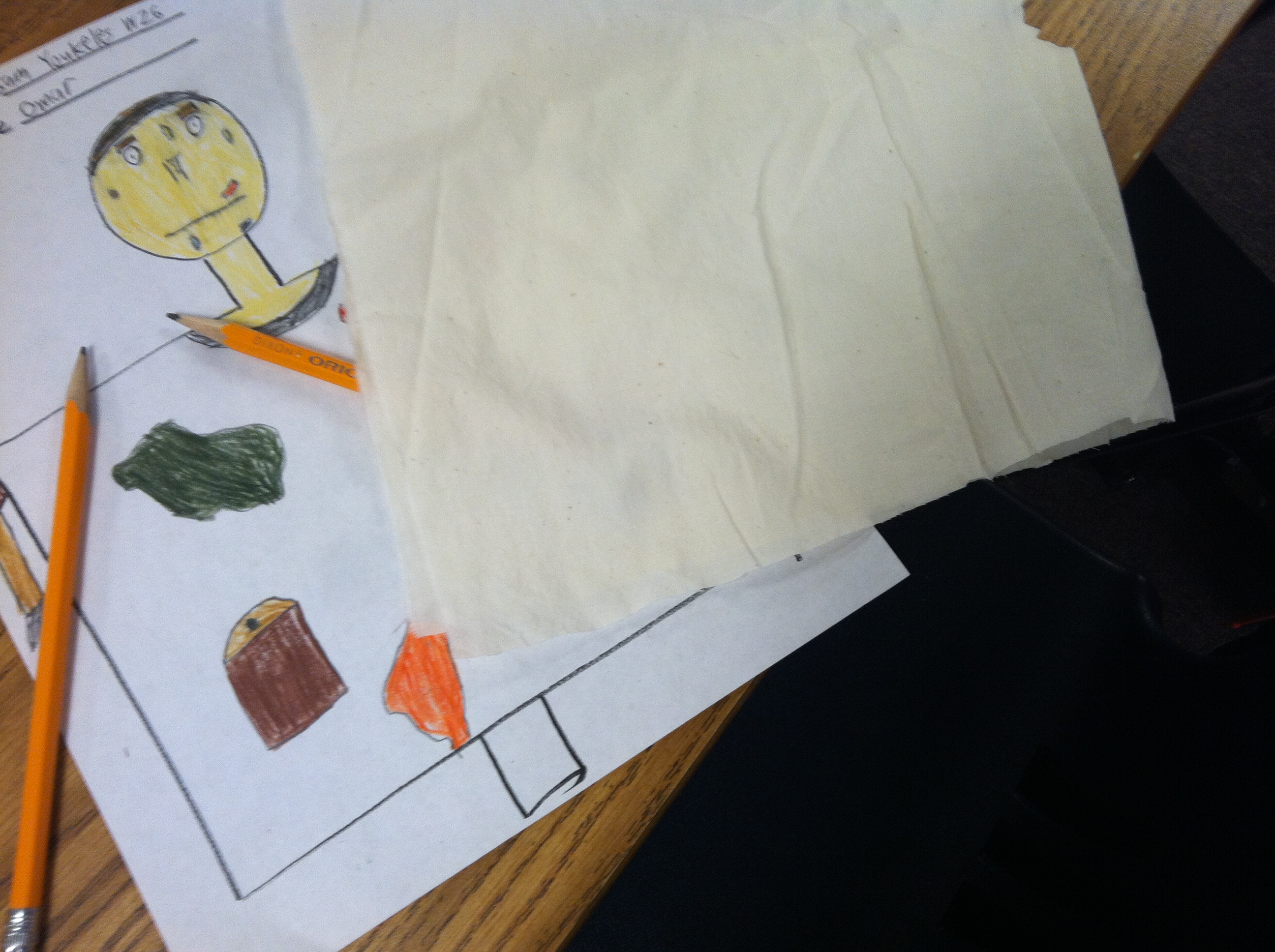
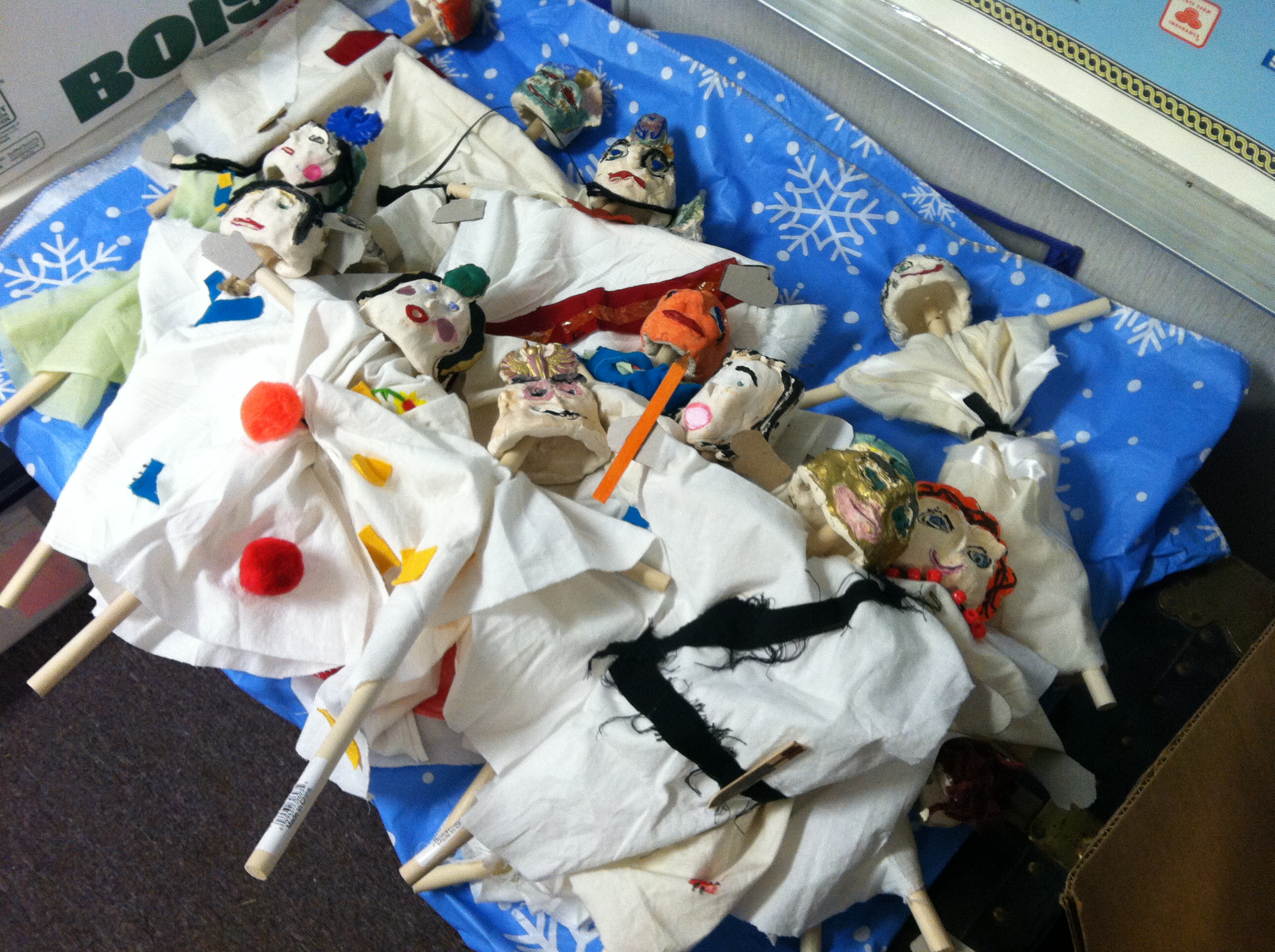
I was thrilled to be able to return this month to Tuckahoe Elementary, where I used to teach full time, to do a three session arts residency with the 5th grade. Their social studies curriculum covers various world cultures, and I collaborated with their classroom, library and art teachers to give the students the opportunity to delve more deeply into Ancient Egyptian society through research, writing and puppetry.
Each student was assigned a particular Ancient Egyptian social group and spent time in the library researching the work, lifestyle, dress and family structure of that group. I then led each class through the steps of creating a puppet character and writing a monologue for them to speak, focusing on the hopes and dreams of their particular person. Some students chose to go dramatic, with generals plotting to kill the pharaoh. Others wrote about characters wishing to move up in status or social group. The students demonstrated their knowledge about the time period and their social group through the details they included in their writing.
In art class, each student created a ceramic head for their puppet, which was fired and decorated. In social studies class with me, they designed and then built a basic rod puppet structure of dowels and a costume of fabric. Again, students were expected to use their research to create a costume and if possible, props for their particular puppet character. When the puppets were all assembled, the students each performed their puppet monologue for the group. They did a wonderful job! Among the comments and feedback we got from the students were “I liked getting to decide how my character reacted to things,” “I liked learning more about all the different social groups by watching everyone” and “I liked making the head and costume of my puppet!” proving that the arts are the perfect way to build a love of learning in students of all ages. If you would like us to bring this or a similar workshop to your classroom, please email us at witsendpuppets@gmail.com.
Flowers and Ladders and Frogs, OH MY!
Rehearsals for Under the Canopy start today! In the midst of the snow last week, we got to set up some of the ladders and other objects in the Athenaeum to see how they look. It was a little odd creating a tropical rainforest in the midst of snowflakes! Here are some photos, and you can buy tickets for the show HERE. We hope to see you there!
So Much COLOR
Under the Canopy is going to be a very colorful show. Can you guess what each of these photos is a close-up of? There’s a slide show of the final objects (as they look right now, things could still change!) at the end.