Puppets and Social Studies

I was thrilled to be able to return this month to Tuckahoe Elementary, where I used to teach full time, to do a three session arts residency with the 5th grade. Their social studies curriculum covers various world cultures, and I collaborated with their classroom, library and art teachers to give the students the opportunity to delve more deeply into Ancient Egyptian society through research, writing and puppetry.
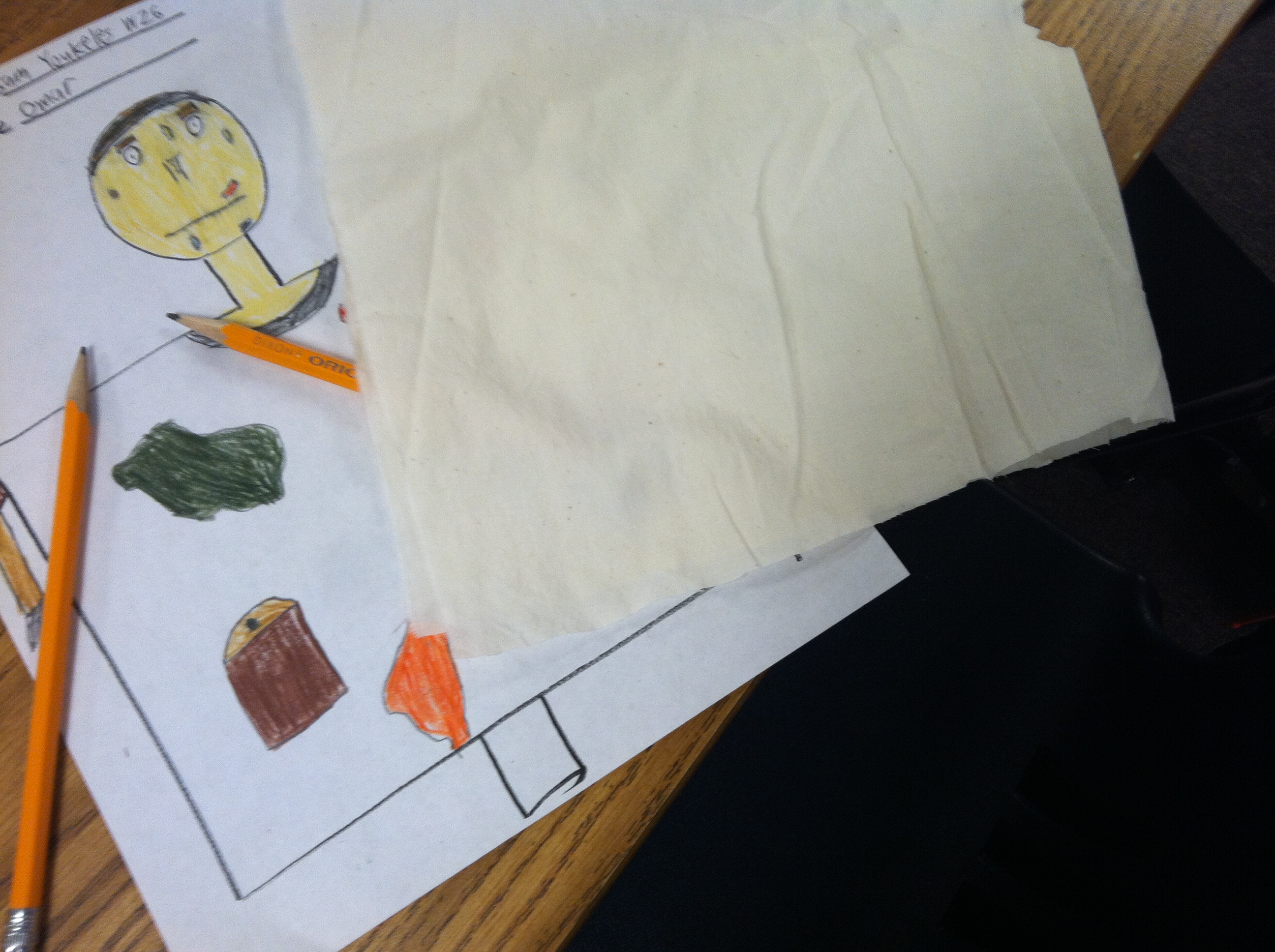
A puppet plan waiting to be turned into the costume using fabric, markers and glue.

A  plan waiting to be turned into a puppet   costume using fabric, markers and glue.

Each student was assigned a particular Ancient Egyptian social group and  spent time in the library researching the work, lifestyle, dress and family structure of that group. I then led each class through the steps of creating a puppet character and writing a monologue for them to speak, focusing on the hopes and dreams of their particular person. Some students chose to go dramatic, with generals plotting to kill the pharaoh. Others wrote about characters wishing to move up in status or social group. The students demonstrated their knowledge about the time period and their social group through the details they included in their writing.
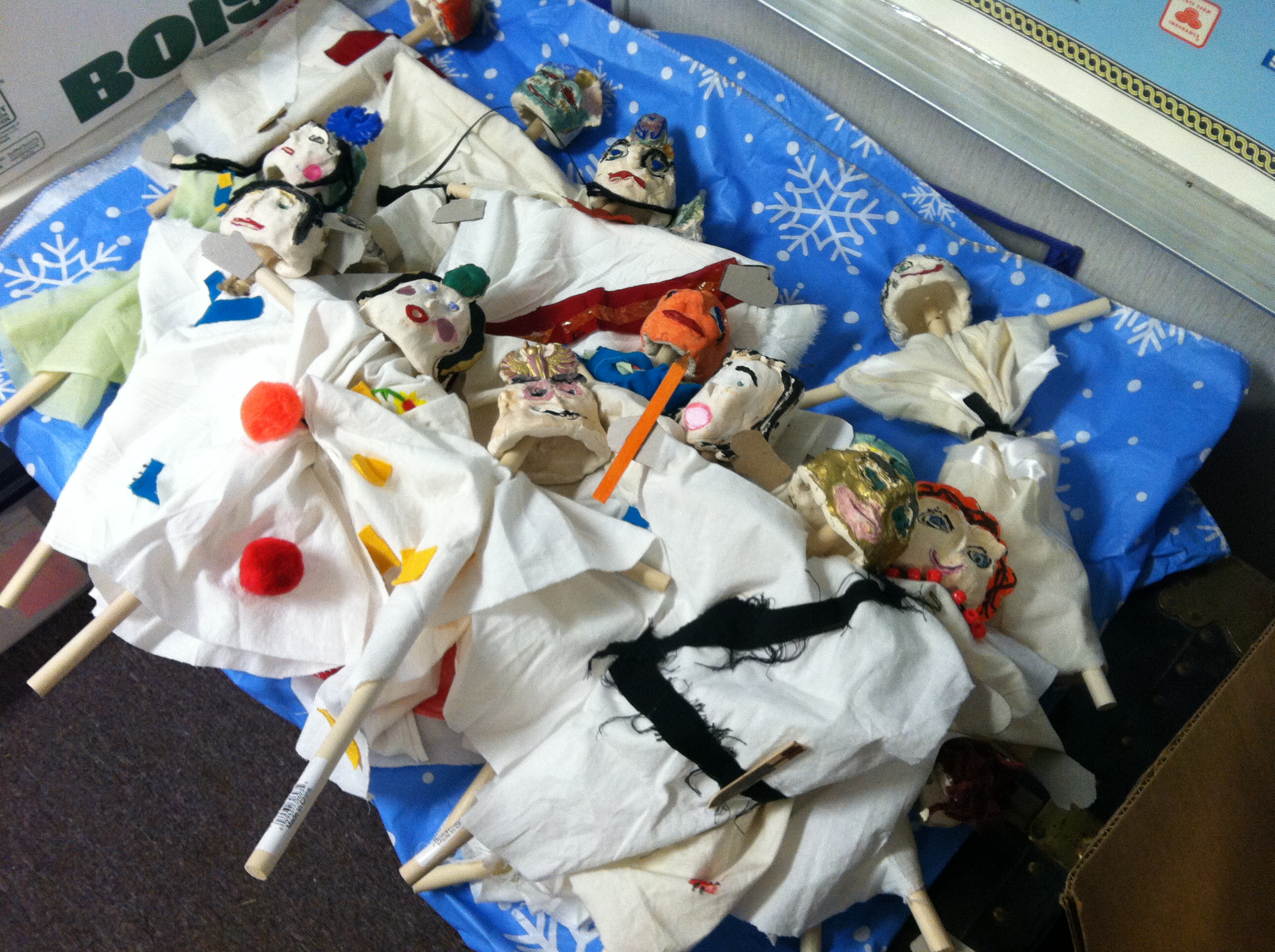
Completed puppets, waiting for the big performance.

Completed puppets, waiting for the big performance.

In art class, each student created a ceramic head for their puppet, which was fired and decorated. In social studies class with me, they designed and then built a basic rod puppet structure of dowels and a costume of fabric. Again, students were expected to use their research to create a costume and if possible, props for their particular puppet character. When the puppets were all assembled, the students each performed their puppet monologue for the group. They did a wonderful job! Among the comments and feedback we got from the students were “I liked getting to decide how my character reacted to things,” “I liked learning more about all the different social groups by watching everyone” and “I liked making the head and costume of my puppet!” proving that the arts are the perfect way to build a love of learning in students of all ages.  If you would like us to bring this or a similar workshop to your classroom, please email us at witsendpuppets@gmail.com.

This slideshow requires JavaScript.

Rehearsing Under the Canopy

In celebration of Under the Canopy, which opens tomorrow at the Athenaeum in Old Town Alexandria, VA here are some rehearsal photos:

The anchor point for the titular canopy, in the center of the stage.

The anchor point for the titular canopy, in the center of the stage.

One of the three ladders that make up the set with leaves, flowers and vines.

One of the three ladders that make up the set with leaves, flowers and vines.

Cast members Nora Achrati and Betsy Rosen work with the objects and puppets to bring the rainforest to life.

Cast members Nora Achrati and Betsy Rosen work with the objects and puppets to bring the rainforest to life.

Rumplestiltskin, Habetrot and Tom Tit Tot

One of the most popular of the Grimm’s fairy tales will come to life in our neighborhood soon, when Imagination Stage in Bethesda opens Rumplestiltskin later this week. Genna is working as an understudy on the show and pointed out a connection to the folklore research we’ve been doing for our next devised project; while the Grimm tale is German in origin, there are numerous British versions of roughly the same story. Comparing these different tales is fascinating, so here are a few points we found especially interesting.

Habetrot, the Border fairy of spinning and an avatar of Rumplestiltskin.

Habetrot, the Border fairy of spinning and an avatar of Rumplestiltskin.

While Rumplestiltskin from the Grimms’ tale is always male, several UK stories, especially from Scotland have a female main character who assists the hapless girl with her spinning. Habetrot, from the Border region between England and Scotland, is the patron fairy of spinning and folklorist Katherine Briggs tells us that  in addition to helping girls with their spinning work, a shirt woven by her was supposed to be a remedy for many different diseases. Whuppity Stoorie (also called Fittletot) comes from further north in Scotland and is described by Robert Chambers as ‘aristocratical’ and all dressed in green, like most fairies. Almost every version of this story in the UK has a character whose name ends in ‘tot’ or ‘trot’, including Tom Tit Tot and Terrytop. Another interesting difference between the German and British versions of the story is the character of the girl who must spin: in the Grimm tale, the miller’s daughter is good and obedient, ending up in her sticky situation because of her foolish father. In the British versions of the tale, the girl is lazy and greedy, lying about her own skills; but through her determination and cleverness she is able to defeat the fairy or devil and end up alright in the end. All versions of the story include the demand for the girl’s firstborn child (or sometimes for the girl herself to go away with the devil), the challenge to find out the true name and then its last minute discovery. Only kindly Habetrot helps out the lazy girl for no reward at all and even convinces the bridegroom that her beauty would be ruined by spinning and so she should never touch a spindle again.

Check out Rumplestiltskin at Imagination Stage if you have kids, and for something a little more experimental, keep an eye out for more information here about our new devised folklore piece. And the next time you tell someone a story, remember that the phrase ‘spinning a yarn’ originally came, rather appropriately, from tales like Rumplestiltskin and Habetrot.

January Grab Bag

A roundup of events and people we highlighted on Twitter this month: 

Giant flower from Under the Canopy.

Giant flower from Under the Canopy. See item #5.

1. The Kennedy Center is hosting a World Stages Festival this March and there will be PUPPETS! Handspring Puppet Company,  that created War Horse, is working on a production of A Midsummer Night’s Dream and Ronnie Burkett Theatre of Marionettes from Canada is doing a show called Penny Plain. There will be puppets on display at the Kennedy Center that you can see for free. So yes. You should go.

2. Puppetry and activism are two of our favorite things. So even though we haven’t actually met in person, we’re big fans of The People’s Puppets of Occupy Wall Street. Hopefully one day we’ll get to work on something with them and maybe it will even involve giant puppet drops of water, like the ones you can see on their Facebook page.

3. All DC puppet fans should check out The Adventures of Alvin Sputnik: Deep Sea Explorerplaying at the Artisphere in Rosslyn from February 6-9. This is a heartwarming story about a deep-sea explorer in search of lost love, told through a combination of sound, puppetry and animation. Created by Weeping Spoon Productions from Perth, Australia, I saw this at the Edinburgh Fringe back in August and am looking forward to seeing it again.

4. Puppets in Prague is an amazing place to learn about marionettes (I did a workshop with them back in 2011) and they have a whole bunch of workshops going on this year. If you’re thinking about taking a trip to Prague (and really, why wouldn’t you be?) check them out.

5. Have we mentioned that we’re going to be at the Atlas INTERSECTIONS Festival this year? With not one, but TWO shows? March will be here before you know it, so you should get moving and buy tickets for our pieces Under the Canopy and Fabulas MayasWith folktales, shadow puppets, and rainforest creatures, you really can’t go wrong!

Flowers and Ladders and Frogs, OH MY!

Rehearsals for Under the Canopy start today! In the midst of the snow last week, we got to set up some of the ladders and other objects in the Athenaeum to see how they look. It was a little odd creating a tropical rainforest in the midst of snowflakes! Here are some photos, and you can buy tickets for the show HERE. We hope to see you there!

This slideshow requires JavaScript.

A Brief History of Puppets and Social Justice

Oxford Dictionaries defines social justice as “justice in terms of the distribution of wealth, opportunities and privileges within a society.” In honor of Dr. King, who fought for equal opportunities for so many, this week we have a short overview of how puppets have contributed and continue to contribute to the fight for social justice.

Giant puppet from the Million Puppet March in DC. November 2012.

Giant puppet from the Million Puppet March in DC. November 2012.

In his 1990 essay “The Radicality of the Puppet Theater,” Peter Schumann calls puppetry “…conceptual sculpture…uninvited by the powers-that-be.” Over the centuries, the low status of puppets in the art hierarchy has allowed them to be agitators for justice, the perfect mouthpiece for complaints about the government. Today puppets are used by  theaters and activist groups across the US as an essential visual component of protests as well as a way to empower communities for fight for necessary change. While this is far from a complete picture (read this essay for more information), here is a short overview of the history of puppetry and protest.

Puppetry has always been a transient art form. From medieval times through the nineteenth century, puppeteers moved from place to place, often performing outdoors rather than inside theaters. As Italian commedia characters such as Pulcinella travelled from country to country, these archetypal figures took on local characteristics and became distinct. However, whether they were named Kasperle (in Germany), Karagioz (in Turkey) or Punch (in England), all of these puppets entertained by breaking rules, upsetting authority and sometimes commenting on local issues and problems of the day. In early nineteenth century France, an out of work silk worker and dentist named Laurent Mourguet created the character Guignol, who became a voice for the working people of France disenfranchised by the combination of industrialization and economic depression. Later in the twentieth century, as protests multiplied in the 1960’s, puppets (especially giant ones) became a widespread part of the action.

The most famous puppet theater associated with protest is probably Bread and Puppet Theater, located in Glover, Vermont and formed in 1963 by Peter Schumann. Originally based on the Lower East Side of New York City, Schumann began by creating shows about local problems and eventually moved on to deploring unchecked capitalism, the Vietnam War and other national issues. Bread and Puppet still takes their puppet and circus shows (always with live music) on tour each year and creates massive community circuses each summer at their farm in Vermont.  Two other companies that provide puppet support to activists on a range of issues are the People’s Puppets of Occupy Wall Street, in New York City and Puppet Underground, in Washington DC. Run by volunteers, they hold workshops in puppet-making and create large and small scale puppets and artwork for protests.

Over the years, several groups that began by working on protests and activism have started to also provide educational resources and community arts support in various cities around the country. Wise Fool Puppet Intervention began as an arts group adding visual impact to activist events in California, and artists with the group later founded Wise Fool New Mexico, which seeks to empower people through puppetry and circus arts. In Philadelphia, Spiral Q Puppet Theater provides arts programming to schools, support for communities trying to express a vision of change, and leadership training for young people. Across the country, puppets are still speaking for those with no voices; still part of a movement toward change for the better.

So Much COLOR

Under the Canopy is going to be a very colorful show. Can you guess what each of these photos is a close-up of? There’s a slide show of the final objects (as they look right now, things could still change!) at the end.

1. IMG_1328IMG_13292.IMG_13313.IMG_1330 4.IMG_13325.
IMG_1334

This slideshow requires JavaScript.

December Grab Bag

Puppets at the Smithsonian. Photo from www.si.edu

Puppets at the Smithsonian. See Item #2.        Photo from http://www.si.edu

A round-up of events, exhibits and shows we’ve highlighted on Twitter this month:

1. Will you be up late on Christmas Eve, wrapping gifts? Turn on CBS at 11:35 pm to see this Nativity show with puppets from the late Jane Henson. Remounted by Cheryl and Heather Henson as a tribute to their mother, it looks like it will be an amazing performance.

2. If you’re showing family around DC this holiday, be sure to stop by the American History Museum on the National Mall and check out the puppetry exhibit on display. With a whole group of famous puppets, it should be fun for puppeteers or anyone interested in pop culture.

3. I’ve spent many hours watching The Muppet Show, but somehow I missed this lovely segment with puppeteer Bruce Schwartz animating a ballerina that was part of a show with guest star Cleo Laine. Start at about 3:30 to see the dance (or just begin at the beginning if you want some quality time with Dr. Julius Strangepork).

4. Puppets have been sadly lacking in American television since The Muppet Show ended in 1981. Fortunately, for those of us who prefer talking puppet heads to talking human heads when it comes to politics, Fusion is now producing No You Shut Up, a topical news show hosted by comedian Paul Tompkins and a panel of four puppets.

5. And finally, Pat came across the Irish theater company Branar through a local film festival. With magical wordless shows for children and elegant, minimal sets, this is our type of theater. Fingers crossed we get to visit Ireland one day and see their work in person.

Favorite Tool: Watercolor Pencils

IMG_1285I haven’t done one of these posts in awhile! For both our children’s shows this year, we were very specific about colors and having the right shades for each story and environment. Much of the time, our initial sketches and planning for puppets is done quickly with a basic pencil and paper, but lately Genna and Amy have been adding color with these watercolor pencils.

IMG_1286

What makes these different from regular colored pencils is the way you can brush over your picture with water to blend colors and create a smooth shade. We don’t always do that, but the colors add a lot to our puppet sketches, as you can see here.

IMG_1287

Building Under the Canopy

We’re in the midst of refurbishing old objects and building new ones for Under the Canopy, which Arts on the Horizon will produce in February. After a workshop production last summer, we learned a LOT about how babies respond to objects and what kinds of things capture their attention best. Here are a few photos of us at work as we build umbrella birds and caterpillars, ladder trees and butterflies.

Supplies waiting on the worktable.

Supplies waiting on the worktable.

Pieces for the umbrella bird, waiting to be glued on.

Pieces for the umbrella bird, all cut out and waiting to be glued on.

All glued or sewn on, now waiting for bird tails.

All glued or sewn on, now waiting for bird tails.

Amy and Genna at the worktable.

Amy and Genna at the worktable.

Genna trying out placements for the bird tails.

Genna trying out placements for the bird tails.