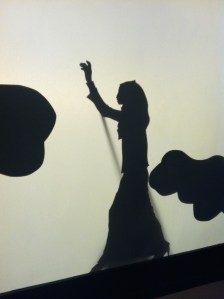
I was lucky enough to take a workshop with shadow puppet artist Gabriel von Fernandez when I was in Argentina back in November. Based in Buenos Aires, Gabriel performs his own shadow puppet shows and teaches workshops to artists at all levels. Here is a page from my journal about my experience working with him.
Meet Emily Marsh
We’re super excited to welcome Emily Marsh to the Wit’s End team as a puppeteer! She will be performing in Saudade at the Atlas INTERSECTIONS Festival at the end of February.
Emily Marsh is a singer, actor, puppeteer, and teaching artist based on the east coast. In 2013 she graduated with a BFA in theatre performance from Virginia Commonwealth University. Emily also received training at the Dah Theatre International School, an experimental theatre company based out of Belgrade, Serbia. As a puppeteer Emily has performed all over the midwest as a part of Madcap Puppets, a puppet company based out of Cincinnati OH. She has also performed with Brooklyn Puppetry Arts and interned with Lone Wolf Tribe, a puppetry companies based out of NYC.
As an actor Emily has performed both internationally (Cibiu International Theatre Festival) as well as locally (Imagination Stage, Capital Fringe Festival, KP Educational Theatre) Favorite credits have included Emily’s self-produced solo show Transfixed By the Dahlia performed as part of the United Solo Festival in NYC, and Beirut at Shafer St. Playhouse in Richmond VA. Emily is very excited to be a part of Wit’s End Puppet’s premiere performance of Saudade. When Emily isn’t playing pretend or wiggle dolls, she enjoys causing a ruckus and eating breakfast for dinner.
January Grab Bag
A round-up of videos, links and articles that we highlighted on Twitter this month.
1. These gorgeous shadow puppet photos, based on various mythologies that explain the Northern Lights, were created for Kinfolk magazine.
2. We have fantastic museums here in DC, but I’ve been wishing I could get to Chicago to see this exhibit of puppets at the Art Institute of Chicago.
3. Puppets can illustrate real world issues as well as ancient mythologies. One of our Twitter followers called our attention to this article about Ebola, illustrated with two-dimensional puppets.
4. The creator of the puppets for that article is Jons Mellgren, a director, illustrator and writer from Sweden. Here are photos of one of his stop-motion puppet films, called ‘Paperworld.’
5. Sometimes I think that I must have read every single article and interview with illustrator Shaun Tan. I don’t think I’ve shared this one though, which is a conversation with Neil Gaiman, one of my other favorite writers. It is quite delightful and I hope you enjoy it!
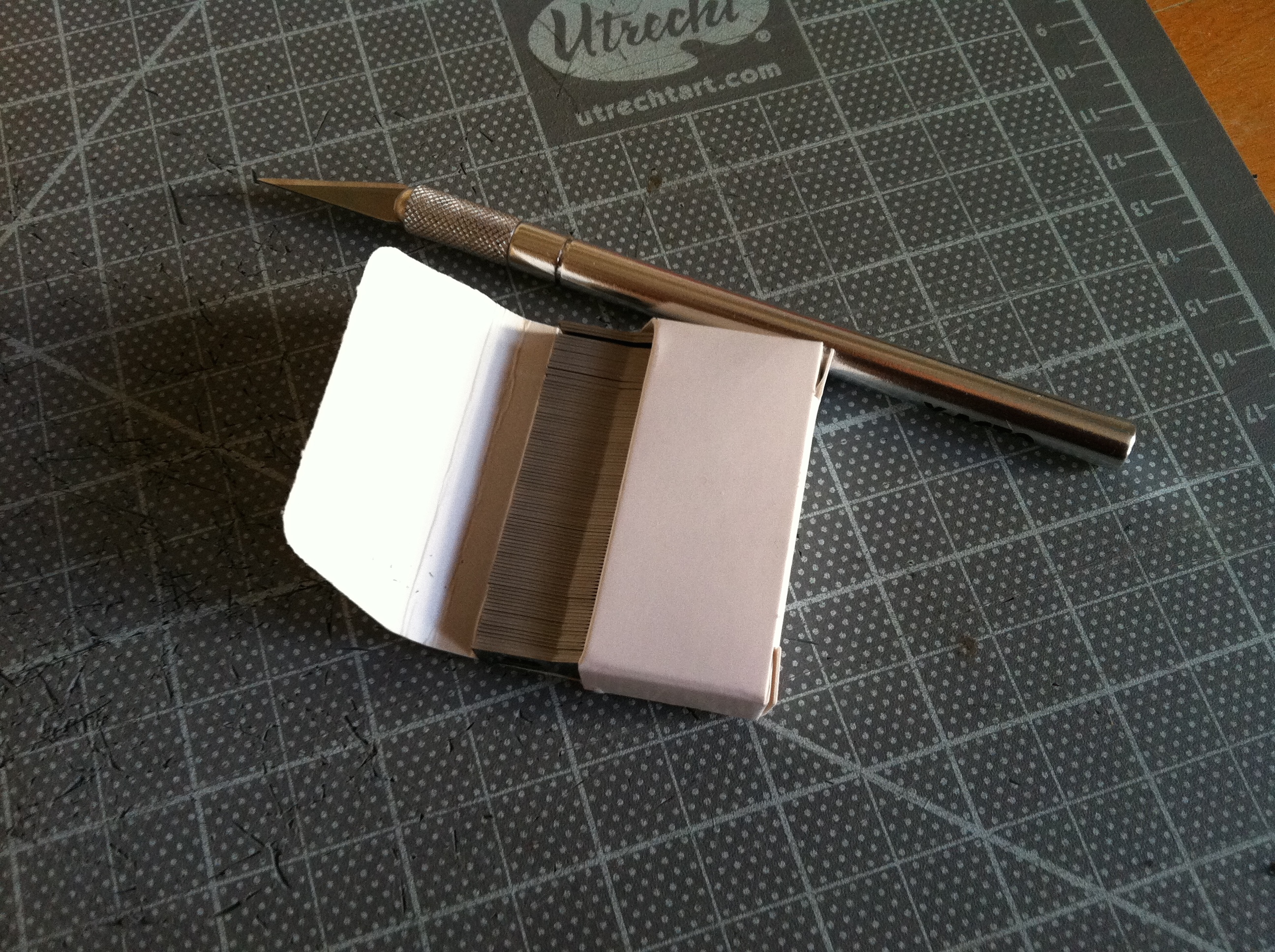
Favorite Tool: X-acto Knife
As we continue to work on building Saudade, my favorite tool has to be this simple X-acto knife and box of blades. When you’re cutting detailed puppets or crankie scenes, a sharp blade is absolutely essential. It’s easy to switch blades quickly with this knife and having a full box of blades means I can pull out a fresh one every few minutes. With shadow puppets, you want every line to be smooth and clean, so it appears as clearly as possible to the audience. This is my favorite tool for making that happen!
You can see Saudade as part of the 2015 Atlas INTERSECTIONS Festival on February 28 at 2:00pm and March 7 at 7:00pm. Performances will be at the Atlas Performing Arts Center on H St. NE. See you there!
Building SAUDADE #2
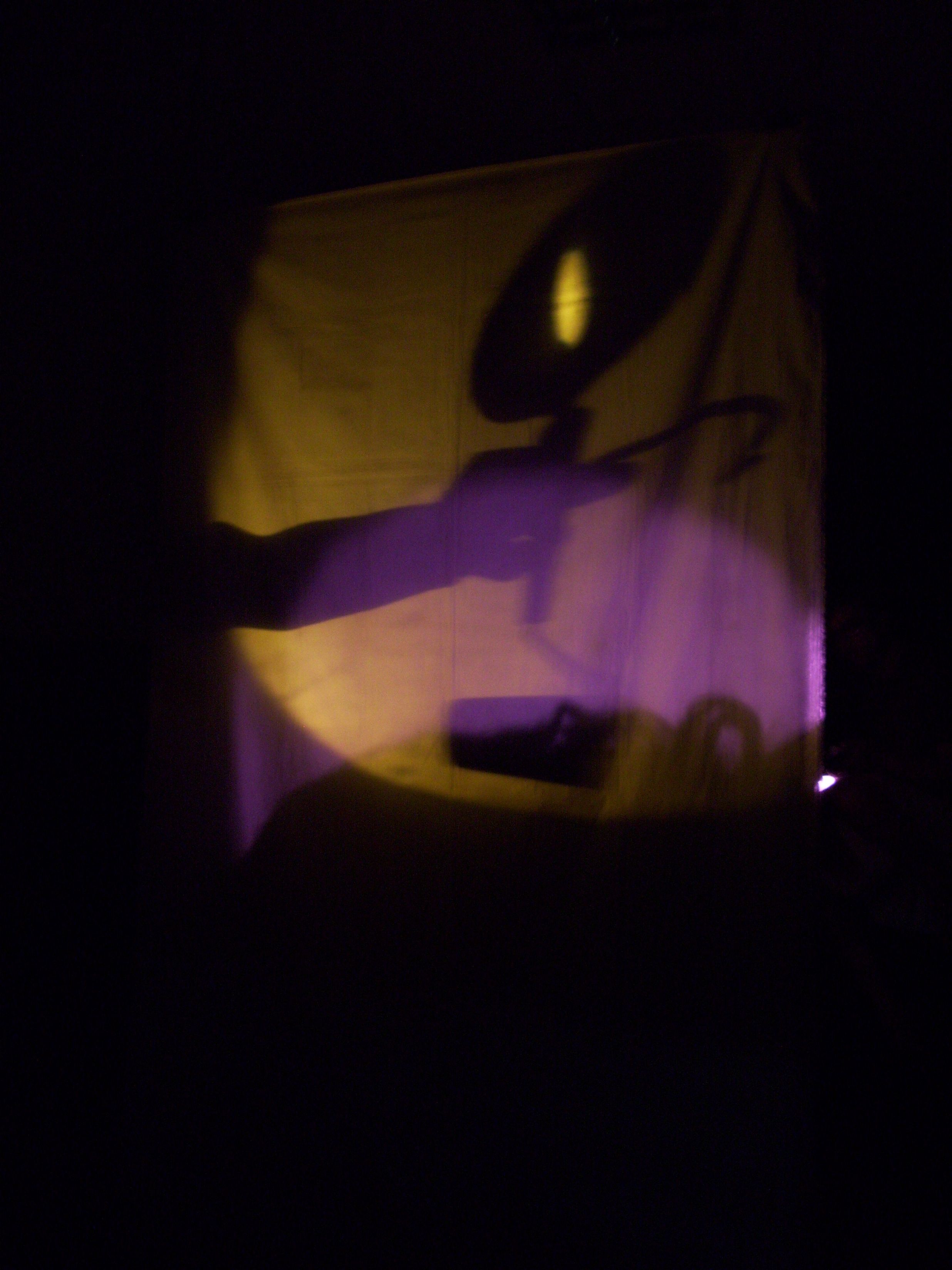
In shadow puppetry, the light is as important as the puppet. In reality, you are manipulating not the object but the space between the object and the light. Not surprising, then, that we spend a lot of time playing with different lights, lightbulbs and light placements to see what works best for any given show. Since this is the first time we’ve used our new screen setup created by Genna, experimenting is the name of the game. A few photos from the week:
5 Reasons to Make Shadow Puppets
There are oh so many reasons why I love making shadow puppets. Let’s list a few of them:
1. Simple materials and tools. Often when I say that I make shadow puppets, I get the response “Oh, you mean with your hands?” The oldest form of shadow play was probably created with human hands, but today you can use cardboard, thin plastic folders, and tape to cut out and put together whatever kind of puppets you imagine. No need to invest in expensive equipment or materials–shadow puppets can be made with the contents of your desk drawer.
2. If you can use scissors, you’re good to go. It takes a lot of practice to successfully create a puppet using some methods, such as woodcarving. Other methods are easier, but can quickly get messy (like paper mache). Shadow puppets, however, only require the use of a normal pair of scissors, or maybe an x-acto knife. You might still want to supervise very young children trying their hand at it, but this is a puppet form that all ages can attempt with confidence.
3. Transformation is magical. One advantage of shadow puppetry is that you can achieve lots of different effects with just one puppet. At a workshop I took in Argentina, we played with using two light sources, varying the distance between screen and puppet and the angle of the puppet. You needn’t feel restricted to flat cutouts in shadow puppetry either–try playing with images of your hand, objects and furniture as well. With all the pieces hidden behind the screen, the audience will be amazed as your puppet grows, shrinks and turns into someone new in a matter of seconds.
4. Join a very, very old tradition. There’s no real way to be sure, but I’d say it’s likely that the earliest form of puppetry was when people sitting by fires thousands of years ago in caves started to manipulate the shadows thrown by the flames. This is an art form that has changed and mutated many, many times over the years and is still in the process of growing. Why not join in?
5. A lesson in simplicity. Getting to the essence of a story, character, or action is often the hardest part of creating a puppet show. Because shadow puppets are usually a silhouette, they require even more care in the choosing of an image. Shadow puppetry is a wonderful way to find the core of the story you are trying to tell and how best to communicate it to your audience.
Building SAUDADE #1
We’re in full puppet-building mode right now for Saudade, our next original puppet play which will premiere as part of the Atlas INTERSECTIONS Festival in DC at the end of February.
This piece is all shadow puppets, which are being designed by Katherine Fahey, a crankie artist from Baltimore whose work we’ve been in love with for awhile. Here’s Katherine at one of our design meetings, looking mischievous:
Saudade will use a setup similar to our piece Coyote Places the Stars in the sense that it uses multiple screens, but visually it will be much, much bigger. You can see Genna here, posing with the PVC frame she’s been working on to support all the screens:
While not a traditional linear story, this play draws on the experiences of immigrants to the DC area, many of whom I had the pleasure of interviewing last summer through a partnership with REEP, an adult education program that is part of the Arlington Public Schools. Now I’m finally getting to cut out puppets of characters inspired by these incredible people, who bring so much to our communities here in the DC area. We’re looking forward to sharing their stories with you, too.
Postcard #10
Goodbye 2014…Hello 2015!
We’re heading into a new year, with new projects and adventures on the horizon. Thank you for reading our blog this year, for coming to our shows, for commenting on Facebook or Twitter and cheering us on. The audience is an essential part of any performance work and we value every single one of you, either online or in real life. We hope to see you again soon!

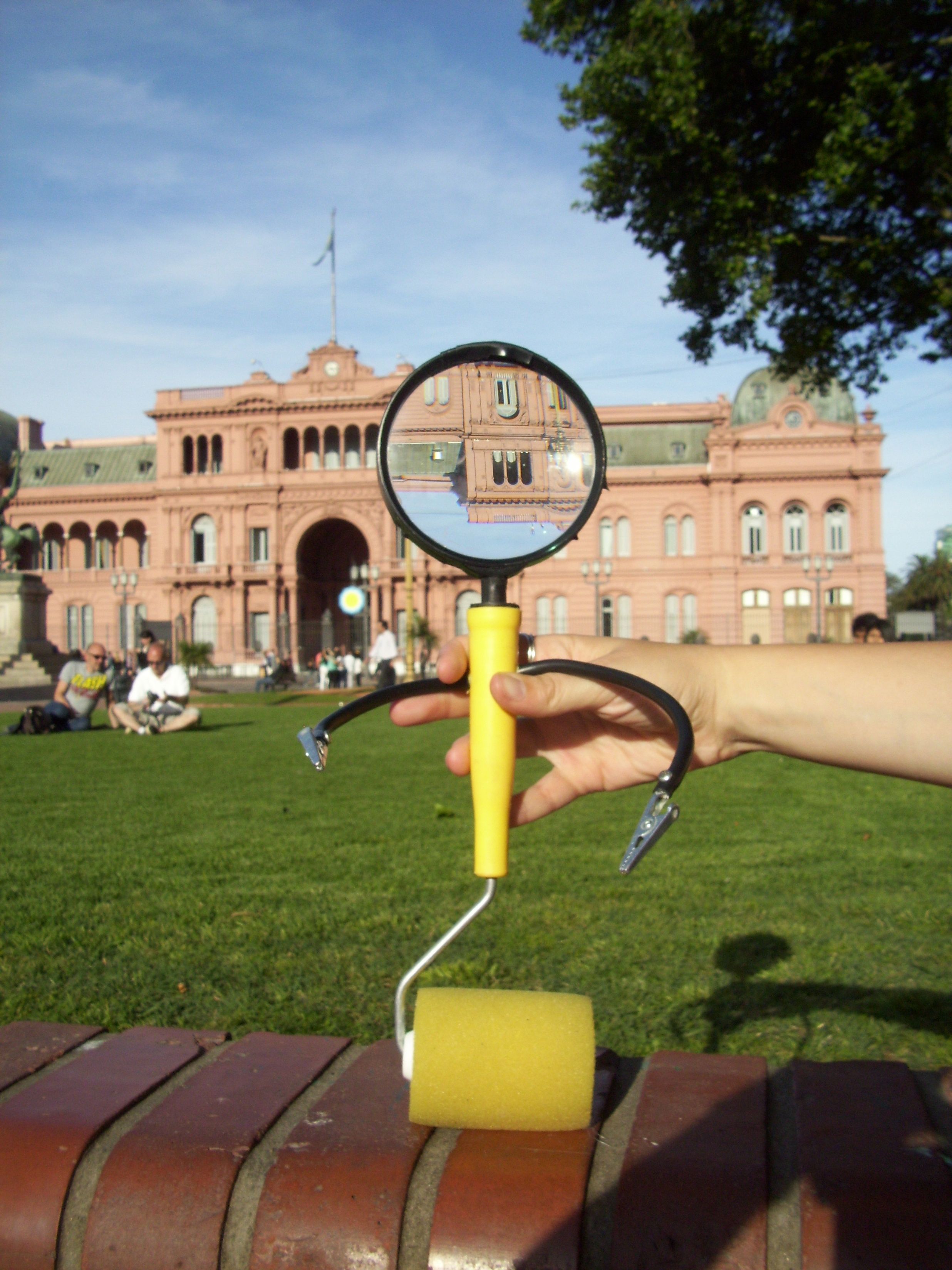
Kismet hanging out in front of Casa Rosada, one of the most well-known buildings in Buenos Aires, Argentina.