Our Folklore Project has a NAME!

Names, as anyone familiar with myth and supernatural creatures will tell you, have great power. So we are beyond excited to be able to announce the name of our next devised theater piece:

MC-title-DKNorthumbria

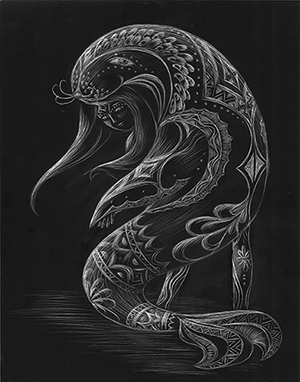
Selkie, artwork by Jordis Brier

Selkie, artwork by Jordis Brier

Inspired by traditional fairy beliefs of the British Isles, we are creating puppets of various malevolent creatures based on designs by artists from across the US and beyond. We will be inviting audiences to interact with supernatural creatures of legend and mythology in the spirit of a choose-your-own-adventure book.

Follow this blog (or Facebook and Twitter) for more updates and mark your calendars for our work-in-progress showing on June 26 & 27 at GALA Hispanic Theatre!

Building a Puppet Ballet: Interview with Genna Davidson

This week, our managing director Patricia Germann spoke with Wit’s End artist Genna Davidson about her recent work constructing puppets for Pointless Theatre Company’s newest show, Sleeping Beauty: A Puppet Ballet, which is currently running as part of CulturalDC’s Mead Theatre Lab program.

Patricia Germann:  What puppets did you work on?

Genna Davidson:  I primarily worked on Sleeping Beauty, the Prince, and the Witch who turns into a dragon.  I worked on all of them, actually, but those are the primary ones.

Puppets in rehearsal. Photo by Genna Davidson.

Puppets in rehearsal. Photo by Genna Davidson.

PG: I recall that Pointless did a version of Sleeping Beauty before. Did they learn lessons from the last production, in terms of how they wanted them to move, or how they wanted them to be built?

GD: They needed the puppets to be way lighter.  Because for the first production of the show they had made them all out of papier-mâché and wood; they were super heavy.  They also wanted the puppets to have a lot of flexibility – but not limitless flexibility, because that makes them hard to control.  So I contributed the bodies, the structures, the new innards and forms of the puppets focusing on building with lighter materials.

PG: You had told me before that the company went to ballet classes.  Did that experience affect how you were building the puppets, or modifying them during the rehearsal process? 

GD: One thing we learned is that these puppets – because it’s ballet – they stand mostly in turnout. When I made the Prince, I made his legs with feet and knees pointed forward. At some point, we realized this means the puppeteer has to always be turning the feet out.  It would be much easier to just have them built in turnout, and then the puppeteer can turn them in as needed, which is almost never.  So I adjusted them on the Prince, and then when I made Sleeping Beauty, I made her legs in turnout. 

Sleeping Beauty in performance. Photo by Gene Carl Feldman.

Sleeping Beauty in performance. Photo by Gene Carl Feldman.

PG: Were the puppets pretty durable?  I’m thinking back to our own experiences with having to repair puppets over a run.

GD: From every project that we do, I learn more and more.  I’ve been very happy with some of the joints of these puppets, in particular the ones which I chose to make elastic from the get-go because of wanting to allow the puppeteers to extend through the ballet movements and then settle back; more breath.  So at important junctures, they have thick fabric-covered elastic joints.

Their spines are really cool. They’re made out of dishwasher drainer hose, which is connected to PVC with hose clamps and plumbing parts.  So there’s lots of plumbing inside!  The drainer hose allows for lots of flexibility, so that the spine can actually arch backwards and forwards.

I had to rig the head in such a way to allow for rotation to the right and left independent of the neck which can only get easy movement arching forward and backward.  Imagine a wooden dowel coming out of the  bottom of the head and inserting within a hollow cylinder, the spine. The heads can spin 360 degrees, but the reason that the head is staying inside of…or one part of the neck is staying inside the other part of the neck…is that I ran a piece of elastic along the outside of the spine all the way underneath the pelvis of the puppet and back up again to that dowel coming out of the head.  And that has been – knock on wood – really pretty durable.

PG: We haven’t really talked about the witch-to-dragon transformation.

GD: Basically you have to see it to understand it and I don’t want to give it away.

PG: Did they have a design for that going in, or did you come up with that transformation?

GD: No, I came up with the design.

The witch, built by Genna. Photo by Gene Carl Feldman.

The witch, built by Genna. Photo by Gene Carl Feldman.

PG: Wow, that’s really cool.

GD: Yeah, that one in particular was my feat of magic – but I wish we had had more time to rehearse the transformation.  It took me so long to construct that we were basically in tech and didn’t have long to choreograph it. [The transformation] works well, but I would have liked to suggest some other choreographed movement.  For a couple days, we were worried we’d have to cut the transformation onstage and leave it to happen offstage, which would have been really disappointing.

The one thing we couldn’t make happen was her face turning into a dragon.  We ended up just bringing on this mask and putting it on her face, basically.  It’s done in a way that works, but we had wanted to have the mask incorporated somehow into her as a witch, so that when the transformation happens, it would be like, “Oh, it was there the whole time!”  That was something we had to let go.

I do want to mention Kyra Corradin, who did the sculpting of all the heads.  Even the puppets who were primarily mine in body, she did those heads, and they’re really beautiful.

PG: You were telling me earlier about the challenges of trying to fit a controller into a head that was already built.

GD: Kyra had built these heads and made them hollow because it would make them lighter…but because she has built these kinds of puppets before, she didn’t think about how to build the head control mechanisms into the puppets.  But actually it worked out well because these heads are really well shaped, beautiful and completely hollow. Though it was tricky to get the mechanisms inside and not damage the sculptural work, it was worth it.  If we had had to build the head around the control mechanism, I’m not sure we would have been able to achieve that hollow, light head that she created. So not knowing is a benefit sometimes.

Pointless Theatre Company’s Sleeping Beauty: A Puppet Ballet runs through May 3, 2014, at the Mead Theatre Lab at Flashpoint.  For tickets and more information, visit www.culturaldc.org

This interview was edited for length and clarity.

Puppet Installations at World Stages Festival

Joey, the title character of WAR HORSE.

Joey, the title character of WAR HORSE.

In addition to some fantastic puppet performances at the World Stages Festival, the Kennedy Center played host to several different art installations which could be enjoyed by the general public for free.

IMG_1521

Rod puppets by Handspring Puppet Co.

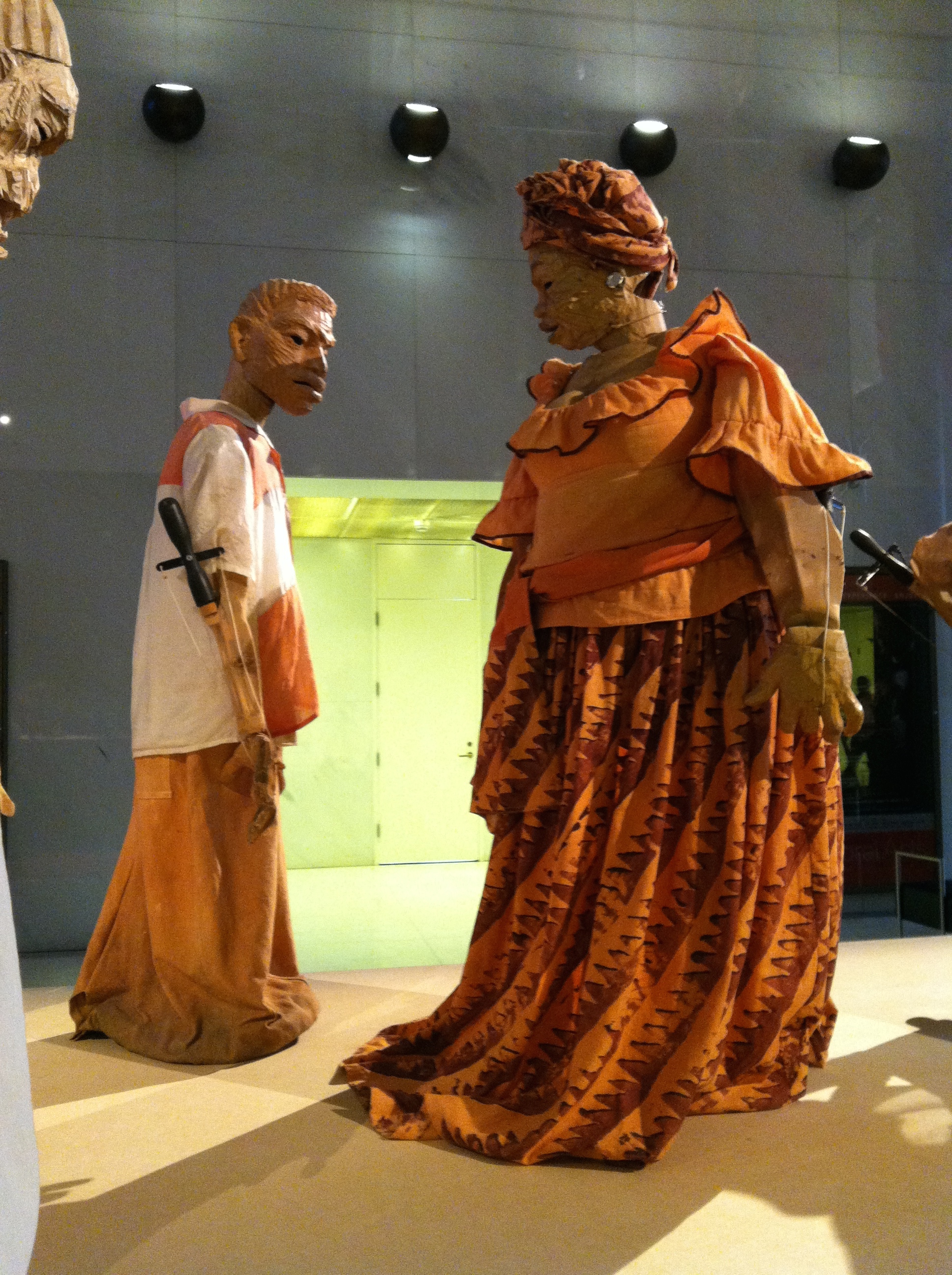
The first installation, Raw to Real, was a series of puppets by Handspring, the South African puppet company best known for the life size horses from the show War Horse. The main equine character from that play is Joey, and he greeted audiences entering the hall. Up close, it was easy to appreciate the complexity of the controls and joints, the care that went into the building and the strain that is put on the wood with the movements of the multiple puppeteers it takes to operate.

IMG_1524

Animal and human puppets by Handspring.

A series of video interviews with various people from Handspring gave insight into the construction process and their main material, which is wood. Additional screens played clips of shows featuring the puppets on display. While War Horse uses life size puppets, many of their other shows use smaller rod puppets, around 3 feet tall. There were many of them, arranged in groups so you could see the relationships between them, some of them in pieces to give a better sense of the research and construction process. The engineering behind each joint is just as detailed and specific as the aesthetic of the face and costume. I really appreciated the fact that the puppets were displayed out in the open, in strong light and with video support to give a better sense of how the puppets operate in performance. While I love seeing different kinds of puppets and museum exhibits are often the best way to find them, it occasionally feels odd to me to see puppets frozen in one position–like any instrument, they are meant to be manipulated and played.

IMG_1532

Sondheim, with the cast of West Side Story.

IMG_1533

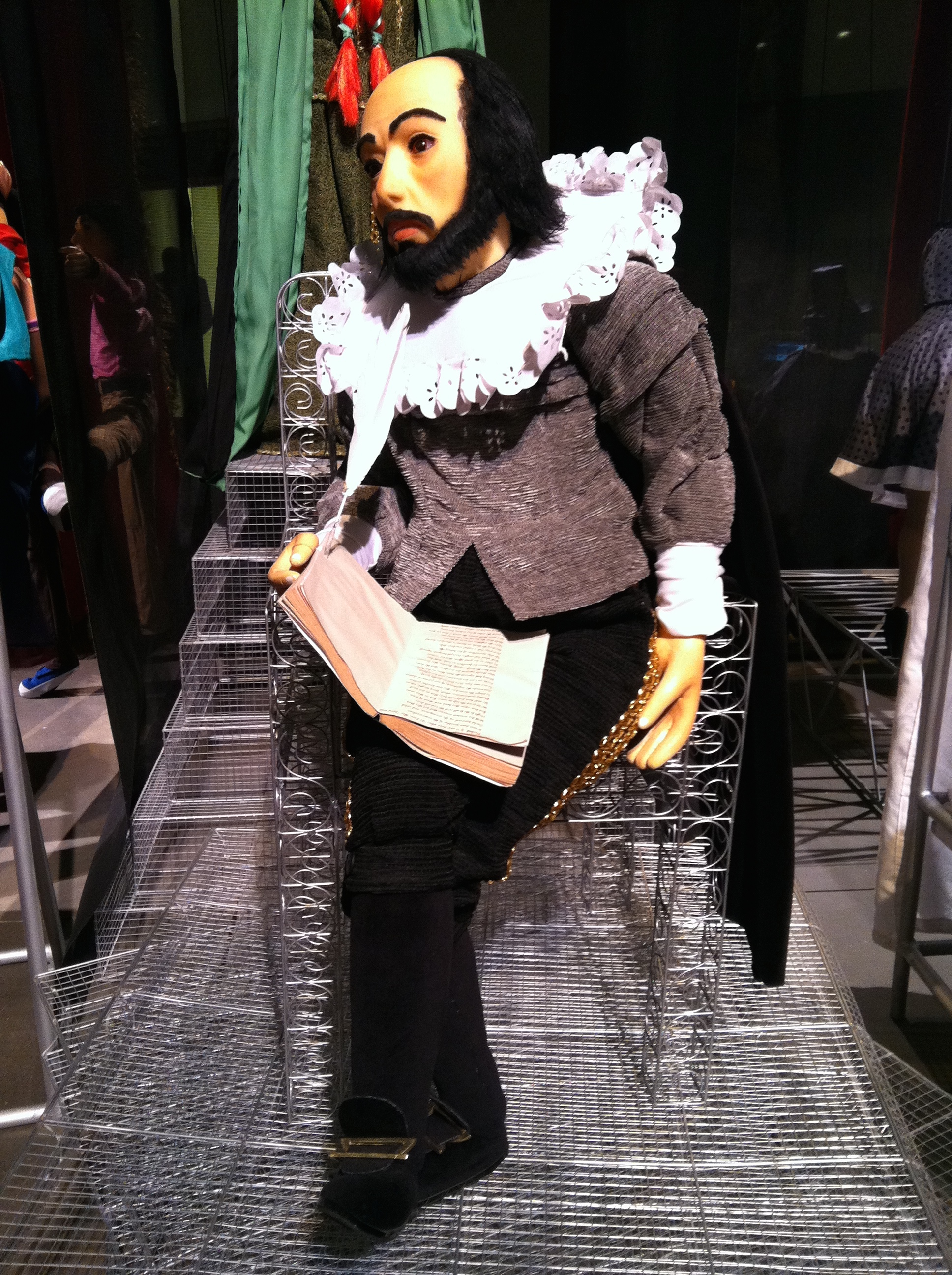
The Bard himself.

The second installation, Pequeno Teatro (Little Theatre) was by Rosa Magalhaes, an award-winning designer from Rio de Janeiro. This one was puzzling to me. It was described as “puppets representing four theatrical writers from different time periods and regions of the world.” While it was fun to see which writers and works were selected, the objects themselves looked like dolls hung on cords, rather than puppets. There were no controls to be seen and it wasn’t clear at all how these ‘puppets’ might be manipulated. This of course begs the question “What makes it a puppet?” Is any object representing something else (in this case, playwrights and characters) a puppet? Even if they were not created for performance, are they still puppets? For me, what identifies a puppet is the intent to bring it to life, and that did not seem to be the case with this installation. The designs were displayed and they looked like costume designs, with no thought given to how to manipulate and move the object–a far cry from the detailed engineering diagrams and studies of the Handspring puppets also on display.

IMG_1525

Puppet designs from Handspring Puppet Co.

I’m very glad that the Kennedy Center chose to give such a prominent position to puppetry at this festival. I applaud the decision to encourage other theatrical designers to experiment with the form of puppetry. I just wish this installation had been pushed a little further, perhaps as a collaboration with actual puppeteers, rather than allowing the playwrights and their characters to simply sit in their theater, with no hint of life in them.

INTERSECTIONS: An Artist’s Perspective

On the way to Atlas for one of our shows.

On the way to Atlas for one of our shows.

Life has been a little overwhelming of late, so it’s taken me a few weeks to be able to sit down and collect my thoughts about this year’s INTERSECTIONS festival. Performing there was a fantastic experience and I want to take the time to share a little of what made it such a special event.

Artists, even when working in groups such as orchestras, or dance and theater companies, can feel isolated. It is one of the ironies of being a working artist that you are often too busy with your own projects to have the time (and money) to see other people’s work. To that end, one of the best things about INTERSECTIONS is that it brings all the artists together in one building. Walking around before and after our show, you could hear snippets of music coming from different theaters, classical mixing with jazz mixing with flamenco. In the lobby between shows you could pick out dancers and musicians talking with audience members, everyone making space for the small children running around with their families. The free cafe concerts in the lobby and art activities for children made the space a welcoming one for audiences of all ages and fans of all kinds of art.

Puppets and instruments on tables backstage.

Puppets and instruments on tables backstage.

INTERSECTIONS takes place at the Atlas Performing Arts Center on H St. NE and all the staff there worked incredibly hard to make us feel welcome and to encourage us to support each other’s work. While each performance was assigned one of the four ‘roadmaps’ (Sound, Movement, Story or Family) everyone was very enthusiastic and interested to hear about what was going on in other roadmaps and other theater spaces. Meetings, parties, and off site events were opportunities to make connections and learn about music, dance and other arts traditions that were unfamiliar. Serendipitous moments abounded (possibly my favorite was listening to Victoria Vox and Christylez Bacon improvising music together).

The Fabulas Mayas team, toasting a sold out show with cupcakes!

The Fabulas Mayas team, toasting a sold out show with cupcakes!

My one regret was that due to my crowded schedule, I was not able to see more performances by my fellow artists. A huge thank you to festival director Mary Hall Surface, and everyone at Atlas for making this such a wonderful experience. I hope to be back again another year!

Our Favorite Puppet Films

Since the film Muppets Most Wanted is opening this week, it seems like a good moment to talk about some favorite films that include puppets. 

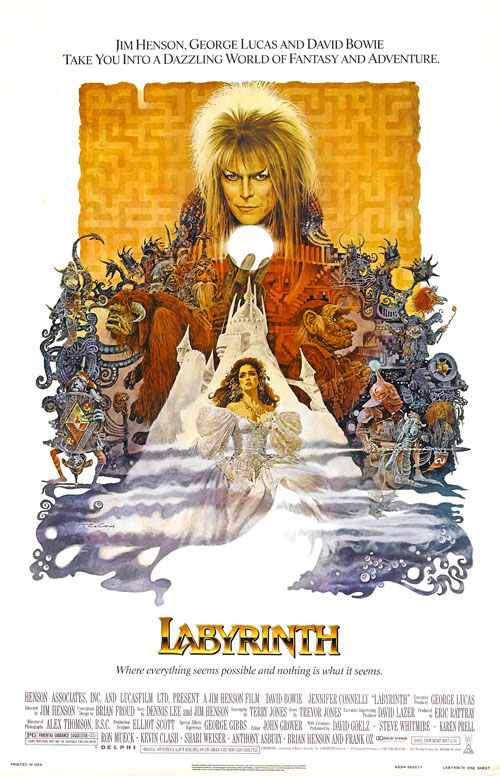
Labyrinth_ver2Genna remembers seeing Jim Henson’s Labyrinth for the first time in elementary school, at a friend’s house. What made the biggest impression on her at the time was the variety of the puppets and how they ranged in dimension. from the giant Ludo to the much smaller Sir Didymus and Hoggle. Genna also liked the way that the human actors (Jennifer Connolly and David Bowie) got to interact with the puppet characters. Today of course she is more interested in trying to understand how each puppet was made and manipulated, and given a choice, she would like to try performing either Ludo or one of the Fire Gang.

file_164905_2_underworld_2_posterThe other film series that Genna has been inspired by is Underworld, a trilogy of movies about vampires and werewolves. Like Labyrinth, many of the characters wear full body costumes with animatronic puppet heads that are manipulated with radio controls by multiple puppeteers. The mechanics of the legs, which have extensions inside the foam latex skin, and the details in the features and hair are all amazing. You can see some of the work it took to produce this in videos here and here.

Cecilia on the other hand, was first introduced to puppets on film with the ‘Lonely Goatherd’ marionettes in the classic musical The Sound of Music. The sequence was performed by Bil Baird and Cora Eisenberg, and the catchy tune, with puppets similar to a set from Mexico that she had, made a big impression on her as a kid. Labyrinth also became a favorite later in college, but the film that was an inspiration as she first started creating and performing puppets in high school was Fool’s Fire, an adaptation of the Edgar Allan Poe short story Hoptoad which was created by Julie Taymor and shown on PBS in 1992. Cecilia came across it as part of a retrospective of Taymor’s work that was shown at the National Museum of Women in the Arts in 2000. The story of a jester who takes revenge on the cruel king and court that enslaves him, it uses full body puppets to establish the difference between Hoptoad and his captors.

Hopefully some kids will see Muppets Most Wanted this weekend and be inspired to pick up puppets! What other puppet films do YOU love?

February Grab Bag

A round up of links and news we highlighted on Twitter this month: 

#1: Still from the documentary THE MAN WHO MADE ANGELS FLY.

#1: Still from the documentary THE MAN WHO MADE ANGELS FLY.

1. The Washington Jewish Film Festival has a documentary about puppeteer Michael Meschke called The Man Who Made Angels Fly playing March 1 & 2! We posted an interview with the festival director earlier this week and will be introducing the screenings, so come see some amazing marionettes!

2. Benedict Cumberbatch gets some counting help from the Count. I think the show Sherlock could use a few puppets.

3. A thought-provoking interview with Cheryl Henson about the potential pitfalls of being labeled a puppeteer.

4. Genna is working with Imagination Stage on their production of Rumplestiltskin for young audiences. We ran into some similar characters in our folklore research this year.

5. Our friend Ashley Hollingshead from Portland OR is raising money for a new devised theater show called Independent Women. Support new theater and make a contribution HERE.

Puppets & Film: An Interview with Ilya Tovbis

poster2wik

Puppeteer Michael Meschke’s life and work are the focus of the recent documentary The Man Who Made Angels Fly (2013), which will be in DC this weekend as part of the 2014 Washington Jewish Film Festival.  Patricia Germann, Wit’s End’s Managing Director, caught up with Festival Director Ilya Tovbis to learn more about the film and its selection for the festival.

Patricia Germann: What led you to select this film for the festival?

Ilya Tovbis: The base qualifier to be in the festival is purely quality and diversity of vision.  So on that characteristic it really stood out.  I think it’s a tremendous documentary, and a unique one at that.  It’s done without almost any interviews, and very little sound that’s not coming directly from what’s happening.  A lot of the film is just the puppeteering happening on stage, and you’re meant to gather that the weighty subjects being discussed, or the Greek tragedies, or the philosophy that’s on stage… You gather what importance they are to Michael Meschke himself.  At times he and his wife talk, but it’s kind of a prime example of the “show, don’t tell” mentality and of a documentary where – especially for me, who’s not a subject matter in puppeteers or the craft – it allowed me to understand it from a very human perspective, and that was immediately attracting.  I think the cinematography is tremendous, the use of light and air, and just space and the pacing of the whole documentary is absolutely fabulous.

PG: It really did come across in the trailer that the puppetry and the puppets support the storytelling aspect of the film.

IT: More so than that, they’re really the prime characters, and I think the reason he agreed to be on film was that he’d be allowed to sort of speak through them and speak through his art more than one-to-one with a moderator before the camera.

PG: You mentioned that you’re coming from a background that is not in puppetry, and I’m wondering what in particular non-puppeteers would get out of this film.

IT: For me, it piqued my interest in puppetry and is something that I hope to look into more post-festival.

PG: That’s wonderful to hear!

IT: A lot of what I saw on screen I would love to see in person, and I just had never considered going to such a show.  So in terms of piquing interest, it’s amazing. Also, his life is a fascinating account.  It’s certainly not exclusive to him, but it is a pretty unique story in that he grew up thinking that he was Christian.  He had some nominal notion of his past and heritage, but he actually found out that he was Jewish as he was being set upon by a mob of people.  He and his mom hid in a church, and he asked her, “Why are these people after us?” and she said, “Well, you happen to be Jewish.” And that’s informed a lot of his artwork.  From a Jewish Film Festival perspective, that’s a tremendous story of finding one’s identity and doing with it something unique. I think that’s why he does the puppetry and why he takes on the stories that he does.  A lot of these stories are grand myths, and it’s evil fighting good, and it’s getting at the root of what humans are and what our universal struggles are.  I think that’s clearly rooted in his personal history.

44431_1

Michael Meschke, puppeteer.

PG: Is there anything else that you wanted to share about this film, or that you think would be of particular interest to the puppetry community?

IT: One thing that’s important for us about this film within the context of the festival is that it’s part of our spotlight on Polish cinema and where that particularly intersects with his stories – Again, this notion of finding out you’re Jewish a little bit later on.  That was quite common in Poland, which is just beginning to grapple with its Jewish history, and it’s become a real topic of conversation recently.  You’re seeing that again in cinema, and a lot of that is about the ‘hidden’ identity and people discovering that they’re Jewish and that their family hid it from them as a means of perseverance and moving forward.  So from that standpoint, it’s in a larger framework of films, but it also is very unique and set apart from the other ones that we have like Mamele and Ida and Aftermath, that all make up that Polish focus.

PG: I’m remembering now from the description that there are a number of different countries credited in the production of this film.

IT: Yes, so it’s a co-production: the filmmaker is Polish and quite a number of the crew are Polish, and also the UK and France – the subject lived there [in France] for a while and much of it happens there.  When you have a number of countries credited, it means that considerable funding or cast/crew (in this case crew, since there isn’t really a cast, being a documentary film) come from those countries, and as film has been globalizing, you notice more and more that those list are getting longer.  It used to be a huge deal if 2 countries collaborated on a film, but it’s becoming increasingly common as the borders come down.

The Man Who Made Angels Fly screens March 1-2 as part of the 2014 Washington Jewish Film Festival. Tickets $12 each. Learn more at www.wjff.org.

Interview edited for length and clarity.

Announcing INTERSECTIONS 2014!

IntersectionslogoWe are thrilled to announce that BOTH our collaborative projects this year will be presented as part of the Atlas INTERSECTIONS Festival 2014!

Under the Canopy by Arts on the Horizon and Fabulas Mayas, co-produced with GALA Hispanic Theatre will each have multiple performances as part of the fifth year of INTERSECTIONS. This festival seeks to connect the broadest possible audience with the most exciting new ways of making community-inspiring art. With performances for all ages and audiences, from music to dance to circus to storytelling and new plays, there is truly something for everyone. Tickets go on sale January 9, so we hope you will join us at Atlas Performing Arts Center on H St. NE from February 21-March 8 to see our shows and some of the other amazing work at the festival. As we get closer, we will have more information here or you can also check out the festival website.

Fabulas Mayas is onstage NOW!

IMG_1137

Come see our first public performance of Fabulas Mayas this weekend at GALA Hispanic Theatre! Our school audiences this week have giggled, given advice to the characters and asked ten thousand questions about the puppets and how they were made. We hope you will join the fun!

WHAT: An hour long show for all ages, adapted from Mayan folktales

WHERE: GALA Hispanic Theatre at Tivoli, 14th & Park Rd. NW. Columbia Heights Metro, parking in the Giant lot next door.

WHEN: 3pm on Saturdays October 26 & November 2

HOW MUCH: $12 adults, $10 students

WHY: Because it’s AWESOME.

May Grab Bag

Kismet is over and so (almost) is the month of May! With all the work at the theater this month, there has been less time to spend online and out and about seeking new and exciting things. But here are a few:

1. FIGMENT DC has submission forms up! We participated in this fun, free arts event last year and had a blast. If you are creative and have an idea for some kind of interactive arts activity, you should sign up! And if you would rather participate in someone else’s imaginative idea, put it on your calendar and come out to Anacostia for a fun time.

Our friends at Blue Sky Puppets will be performing at Strathmore this summer!

Our friends at Blue Sky Puppets will be performing at Strathmore this summer!

2. Strathmore out in Maryland has a whole bunch of puppet theater on tap for the summer, including our good friend Michael Cotter of Blue Sky Puppet Theater. Our friends at Pointless Theatre should be up there too for the puppet slam on August 2, so head over and say hi to them!

3. These photos by Todd McLellan came up on my radar screen via several different sources. Every time I looked at them, I had to restrain myself from going out and finding some particular tiny piece of machinery that I was convinced could become part of a puppet. Mr. McLellan, if you’re looking to get rid of any scraps, we should talk.

4. The International Toy Theater Festival is being hosted by Great Small Works up at St. Ann’s Warehouse in Brooklyn from June 14-23. If you’re in the NYC area, you should check out the amazing work being done at this colossal event of miniature proportions!