Building SAUDADE #2

In shadow puppetry, the light is as important as the puppet. In reality, you are manipulating not the object but the space between the object and the light. Not surprising, then, that we spend a lot of time playing with different lights, lightbulbs and light placements to see what works best for any given show. Since this is the first time we’ve used our new screen setup created by Genna, experimenting is the name of the game. A few photos from the week:

IMG_2191

Should we use a combination of warm and cool light?

IMG_2192

Or all screens lit with the cooler tone?

Genna and Emily work on placing a clip light.

Genna and Emily work on placing a clip light.

5 Reasons to Make Shadow Puppets

IMG_2183

One of the main characters in our new show SAUDADE. See our homepage for more details.

There are oh so many reasons why I love making shadow puppets. Let’s list a few of them:

1. Simple materials and tools. Often when I say that I make shadow puppets, I get the response “Oh, you mean with your hands?” The oldest form of shadow play was probably created with human hands, but today you can use cardboard, thin plastic folders, and tape to cut out and put together whatever kind of puppets you imagine. No need to invest in expensive equipment or materials–shadow puppets can be made with the contents of your desk drawer.

2. If you can use scissors, you’re good to go. It takes a lot of practice to successfully create a puppet using some methods, such as woodcarving. Other methods are easier, but can quickly get messy (like paper mache). Shadow puppets, however, only require the use of a normal pair of scissors, or maybe an x-acto knife. You might still want to supervise very young children trying their hand at it, but this is a puppet form that all ages can attempt with confidence.

3. Transformation is magical. One advantage of shadow puppetry is that you can achieve lots of different effects with just one puppet. At a workshop I took in Argentina, we played with using two light sources, varying the distance between screen and puppet and the angle of the puppet. You needn’t feel restricted to flat cutouts in shadow puppetry either–try playing with images of your hand, objects and furniture as well. With all the pieces hidden behind the screen, the audience will be amazed as your puppet grows, shrinks and turns into someone new in a  matter of seconds.

4. Join a very, very old tradition. There’s no real way to be sure, but I’d say it’s likely that the earliest form of puppetry was when people sitting by fires thousands of years ago in caves started to manipulate the shadows thrown by the flames. This is an art form that has changed and mutated many, many times over the years and is still in the process of growing. Why not join in?

5. A lesson in simplicityGetting to the essence of a story, character, or action is often the hardest part of creating a puppet show. Because shadow puppets are usually a silhouette, they require even more care in the choosing of an image. Shadow puppetry is a wonderful way to find the core of the story you are trying to tell and how best to communicate it to your audience.

Building SAUDADE #1

We’re in full puppet-building mode right now for Saudade, our next original puppet play which will premiere as part of the Atlas INTERSECTIONS Festival in DC at the end of February.

Saudade7

This piece is all shadow puppets, which are being designed by Katherine Fahey, a crankie artist from Baltimore whose work we’ve been in love with for awhile. Here’s Katherine at one of our design meetings, looking mischievous:

IMG_2141 Saudade will use a setup similar to our piece Coyote Places the Stars in the sense that it uses multiple screens, but visually it will be much, much bigger. You can see Genna here, posing with the PVC frame she’s been working on to support all the screens:

IMG_2157

While not a traditional linear story, this play draws on the experiences of immigrants to the DC area, many of whom I had the pleasure of interviewing last summer through a partnership with REEP, an adult education program that is part of the Arlington Public Schools. Now I’m finally getting to cut out puppets of characters inspired by these incredible people, who bring so much to our communities here in the DC area. We’re looking forward to sharing their stories with you, too.

IMG_2115

Next Steps

Puppets have to wait patiently until we're ready to work with them again.

Puppets have to wait patiently until we’re ready to work with them again.

We had our last story meeting of the summer for Malevolent Creatures this past week and we are heading into the fall with many new ideas and renewed energy. If you missed our first workshop in June, keep an eye on this space for more info about our next one. We hope to see you there for some magical puppet encounters!

An Interview with Amelia Gossman

This week Wit’s End Artistic Director Cecilia Cackley interviewed artist Amelia Gossman about her experience working as an illustrator on Malevolent Creatures, our upcoming project based on British and Celtic folklore.  

Cecilia Cackley: When did you first learn about the character of Black Annis (aka Black Agnes)? What drew you to her?

Black Annis, artwork by Amelia Gossman

Black Annis, artwork by Amelia Gossman

Amelia Gossman:  As a kid, I was really into folklore and faeries. My best friend and I would look at Brain Froud books when we were eight and run around the woods looking for and trying to lure the creatures we read about. I believe in his book, “Good Faeries/ Bad Faeries” he gives a brief description of her. For my senior thesis in college, I wrote an analysis of Welsh/English folklore and I learned more about her in depth. I chose to write about her because bot only is her back story is really interesting, the added creepiness of cannibalism makes her, for me, one of the scariest creatures. And being scary is intriguing.

CC:  I know you did a project on her in art school. Can you describe it and talk a little about what it entailed?

AG:  I mentioned that I wrote about her for my senior thesis. My minor at MICA was Creative Writing, and for our final project we were given the freedom of writing about whatever topic we wanted. The analysis covered the origin of certain folktales and how those stories related to the current culture (i.e. faeries had kings, queens, and knights much like the British monarchy). I spent the entire school year gathering information from various sources and condensing that information in an organized way. A big challenge was targeting ONE area, so I stuck to the British Isles. It was just too much to include all the creatures I wanted to (that meant no Minotaurs, fauns, or kappas, just to name a few!)

Amy getting set with the rehearsal puppet of Black Annis. Photo by Patricia Germann.

Amy getting set with the rehearsal puppet of Black Annis. Photo by Patricia Germann.

CC:  What was the most interesting thing you learned about Black Annis in your research?

AG:  Here’s an excerpt of the paper [that I wrote] that focused on her!

The Scots also believe in Wicked Wichts of the Unseelie Court. These bogies were fearsome and inflicted many ills upon both man and beast. They were much more malevolent than the mischievous house spirits. Devilish monsters like Black Agnes would prey upon children. A hag of the Dane Hills near Leicester, England is a blue-faced crone with long claws and yellow fangs, sometimes taking the shape of a cat-demon. She is said to live inside of a cave she personally clawed out from the rocks. She eats the children who stray into the Dane Hills after dark, skinning them and devouring them, later scattering their bones around the hills and hanging their skins from the trees to dry. If children are in short supply, she snatches lambs from the pasture or even babies from the open windows of houses. 

I think her connection to cats was incredibly interesting. It’s not mentioned in the paper, but I remember reading about how a nearby town, lead by its mayor, would drag a dead cat through out the woods near her cave – I think as a warning to her. That’s a great example of folklore being incredibly ensconced in a town’s culture! I should’ve added that!

CC:  Did you approach the illustration for us differently than for your school project?

AG:  Definitely – while I had done research on her, I was able to add some of my own personal ideas to the illustration. I chose to add scarring to her mouth, her large hands and long body, and her ominous clothing – including a crown of bones. I liked having that freedom.

CC:  What was it like seeing the rehearsal puppet based on your illustration?

AG:  Amazing!! She had such a spooky presence because she was so large. I think I had an idea that the show would be almost Punch and Judy scale, and that she might be a little marionette, but I was thrilled to see that she was enormous!

CC:  Was there anything unexpected or surprising about what you saw in the rehearsals for Malevolent Creatures?

AG:  The integration of the audience and the performance was really cool, something I haven’t seen before. I don’t want to give too much away, but I liked thinking I would see a traditional show and being surprised by unexpected visitors. The performers are so talented and the puppets came to life, even though they weren’t finished. It was great!

Carol and Amy demonstrating with the Black Annis rehearsal puppet. Photo by Patricia Germann.

Carol and Amy demonstrating with the Black Annis rehearsal puppet. Photo by Patricia Germann.

CC:  Are there any other folklore characters you think you’d like to illustrate or write about?

AG:  Oh gosh, where do I begin?? I’ve used a lot of creatures in my work in the past (especially fauns, but those are Greek rather than English!). However I would love to illustrate more selkies, will-o-the-wisps, and kelpies.

The Wit’s End project Malevolent Creatures is currently in development for Fall 2015.  Get the latest updates by joining our mailing list or connecting with us on Facebook and Twitter.

Workshop Photos

Puppets are not for the faint of heart. Photo by Patricia Germann.

Puppets are not for the faint of heart. Photo by Patricia Germann.

We had a fantastic two showings of Malevolent Creatures a few weeks ago. If you were unable to join us, here are some photos of the puppets and the process. Check back soon for more information about the next development stage of this show!

This slideshow requires JavaScript.

Not-So-Malevolent Rehearsals

Since we are devising this show rather than working from an existing script, rehearsals are a mix of discussion, improvisation and lots and lots of laughter.  A reminder that our work-in-progress showings are June 26/27 at 7pm at GALA Hispanic Theatre! Tickets are free and you can reserve your spot here. A few photos of the team in action:

IMG_1811

Improvising a set with items in the room.

Carol reacts to a rehearsal puppet.

Carol reacts to a rehearsal puppet.

Sometimes you think better when everyone is on the floor.

Sometimes you think better when everyone is on the floor.

Rehearsal puppet in pieces.

Rehearsal puppet in pieces.

Rehearsal puppet put together and strung on a control!

Rehearsal puppet put together and strung on a control!

A Quick Guide to Puppets

Curious about puppets? Looking for some basic information about how to tell what kind of a puppet you might be looking at? You’ve come to the right place. Puppets are quickly gaining exposure in our popular culture, but they belong to a very old tradition, and are just as diverse as many other art forms. Here are some basics to know:

The definition of ‘puppet’ can be slightly different depending on who you talk to. Most people picture the fabric toy puppets they might have had as children, or the Muppet characters created by Jim Henson for Sesame Street. We often say that a puppet is any object brought to life by an operator, a definition which includes both realistic and abstract characters.

A hand puppet created by a student.

A hand puppet created by a student.

Hand puppets are puppets operated by the puppeteers hand inside the puppet’s body, usually making the head and hands move. Punch and Judy are good examples of traditional hand puppets. Sometimes a hand puppet is operated by two people, such as Telly Monster from Sesame Street.

Rod puppets are puppets with a rod holding up the body and usually two rods controlling the hands or arms. This allows the puppeteer to put some distance between themselves and the puppet. They are traditionally found in southeast Asia, primarily Indonesia.

Czech style marionette.

Czech style marionette.

Marionettes are puppets controlled by strings or wires. A good example of marionettes are the puppets in the movie The Sound of Music. Some marionettes can have up to a dozen strings controlling all the different parts of the body. Marionettes are usually human figures but can also be animals or abstract figures.

Over-life-size puppets is the term used by puppet historian John Bell to describe puppets that are larger than human size or enclose the puppeteer inside the puppet. Big Bird, from Sesame Street is an example of this kind of puppet.

Shadow puppets that we created for Fabulas Mayas at GALA Hispanic Theatre.

Shadow puppets that we created for Fabulas Mayas at GALA Hispanic Theatre.

Shadow puppets are flat cutout figures traditionally seen in silhouette, behind a screen. They can be made of paper, plastic, or leather and are sometimes opaque and sometimes translucent.

Object puppet is a term we sometimes use to describe characters that are created from found objects. All puppets can be classified as ‘object theater’ but these are characters made from a single object such as a hairbrush, fork or pair of binoculars.

Bunraku is a style of puppet originally from Japan. They are usually half or three quarters of human size and are operated by three puppeteers at once.

Malevolent Creatures Research

mythThere have been two main categories of research for Malevolent Creatures. First is the folklore itself: stories, traditions, rituals and beliefs from the British Isles that center around fairies and other supernatural creatures. The second is how those beliefs fit together, how they have changed over the years and the various theories about where they came from and the meanings behind them.

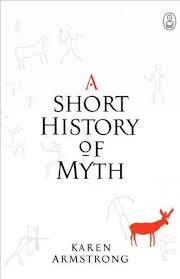
One of my favorite pieces of reading has been Karen Armstrong’s book A Short History of Myth, which traces the evolution of mythology from the Paleolithic period to the present day. In considering the place of mythology in our world Armstrong writes that “The imagination is the faculty that produces religion and mythology…the imagination is also the faculty that has enabled scientists to bring new knowledge to light.” She also points out that “…like science and technology, mythology…is not about opting out of this world but about enabling us to live more intensely within it.”

MCResearchThat intensity is evident in nearly all of the individual stories and beliefs we discovered and is one of the reasons they have been retold and appropriated over and over; by poets, by scholars and by writers of literature for all ages. I am personally very interested in how fairy stories have been rewritten by authors of young adult and children’s literature and one of the pleasures of this research process for me is that it has given me an excuse to re-read some old favorite children’s books that incorporate British and Celtic myth. If you are interested in British folklore but maybe don’t feel like getting into the heavy academic side of things, I recommend these titles as both fun and worthwhile.

The Weirdstone of Brisingamen by Alan Garner

The Dark is Rising (series) by Susan Cooper

The Moorchild by Eloise Jarvis McGraw

The Hounds of the Morrigan by Pat O’Shea

Sneak Peek: Malevolent Creature Designs

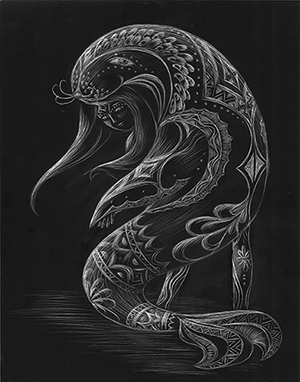
In a few weeks we’ll gather a team of performers to start creating material for our show Malevolent Creatures. But the process of designing the puppets has already started, beginning with research on British folklore and the selection of a cast of supernatural creatures. We gave descriptions of those creatures to artists from across the US and asked them to create images to inspire our puppet-building. Here is a sneak peek at two of them. Both were created by former students at the Maryland Institute College of Art (MICA). The Selkie (a seal that can transform into a human) was created with scratchboard technique by Jordis Brier, an artist originally from Hamburg, Germany and now living in London. Black Annis, a cannibal witch with connections to nature spirits and goddesses, was created in watercolor by Amelia Gossman, from Maryland. We are incredibly excited to turn these images into puppets and we hope you enjoy this beautiful, imaginative art!

Selkie, artwork by Jordis Brier

Selkie, artwork by Jordis Brier

Black Annis, artwork by Amelia Gossman

Black Annis, artwork by Amelia Gossman