September Grab Bag

A round up of links, videos and articles we highlighted on Twitter this month: 

See #1. Photo from The Independent.

See #1. Photo from The Independent.

  1. A huge animatronic bear appeared on the streets of London this summer to protest drilling in the Arctic.
  2. The living doll artist in this article loves it when people ask “Is he real or unreal?”
  3. The otherworldly sculpture of our favorite artist Shaun Tan will seen be on view in this new book. If only we were going to Australia sometime soon!
  4. In a perfect world, we would collaborate with artist Jonathan Latiano to make some puppet dolphins, along the same line as this exhibit.
  5. Fair warning, this video short from France about shadow puppet artist and animation pioneer Lotte Reiniger is profoundly moving and may make you cry. You can read more about Reiniger’s life and work on our blog.

An Interview with Gabriela Cespedes

When Cecilia was traveling in South America last year, she took a workshop with Argentine puppeteer Gabriela Cespedes in the art of caja lambe-lambe puppetry at the Convocatoria de Mujeres Titriteras (Convention of Women Puppeteers). The following is an interview with Cespedes about her work. It has been translated from Spanish and condensed for this blog post. 

Gabriela Cespedes, teaching a lambe-lambe workshop in Argentina.

Gabriela Cespedes, teaching a lambe-lambe workshop in Argentina.

Cecilia Cackley: How did you become a puppeteer? When did you first become interested in puppetry as an art form? 

Gabriela Cespedes: My training comes from acting. I started doing theater in 1988, with Mariu Carreras, a great teacher. It essentially taught me that theater takes place when we are dealing with the public and that is why you always have to create and perform work for an audience. Puppetry came later, in 1996 when I start to do street shows with two colleagues and became forever trapped in the art of puppetry …my interest in this technique must have been born from playing with small things, making houses, staging and playing with friends to make characters.

CC: Are there projects that have changed in response to audience comments? How do you maintain a balance between other people’s criticism and your own vision? 

GC: At first audience comments about a work they had seen affected me a lot and I always tried to change small things … but after a while I realized that art is intimate and solitary, that one can not meet the whims of each viewer … so when someone makes any criticism I take it with respect and affection, and on the other hand I still respect my artwork as I conceived it.

One of Gabi's lambe-lambe shows, set up for spectators.

One of Gabi’s lambe-lambe shows, set up for spectators.

CC: Do you work alone or in collaboration with other puppeteers? Why or why not? 

GC: At this moment all my works are solo … by choice or because it has been easier to move from one place to another by myself with my puppets !!!!
There are plans to work in groups … but we are always organizing activities in conjunction with other puppeteers.

CC: What project are you working on right now? 

GC: At the moment I am researching miniature drawings to use in both stop-motion animation and lambe-lambe theater or caja magica.

CC: What advice do you have for people who want to work with or learn more about puppets? 

GC: The art of puppetry is an ancient technique, captivating, trapping, that allows us to travel into unsuspected worlds … but mostly it is hard work and a lot of research, and that is fundamental to puppetry … and as they say in Japanese “give life to the wood” in that is everything, be able to give life to everything that comes into our HANDS !!!!!

Puppets and Clowning

Some of my colleagues from this trip to Armenia.

Some of my colleagues from this trip to Armenia.

After getting back from Winnipeg, I had just a short break before leaving on another international trip, this time to Yerevan, Armenia with a group of clowns and artists led by Patch Adams. Adams, the founder of the Gesundheit Institute, is a clown, activist and speaker. He saw our show Cabinets of Kismet in 2013 and we have been in touch since then, talking about the possibility of using puppetry on one of these trips.

It was a new and different experience to be working with puppets in an entirely improvised setting, without words (I don’t speak any Armenian) and usually without story. Our group visited hospitals and orphanages in four different Armenian cities, encountering children of all ages. I found that the puppets usually worked best in a hospital setting, or where children had limited mobility. In these kinds of places, we were moving from room to room, often on our own or with just one other person. The intimacy of small numbers meant I could take the time to introduce the puppet, play and let the child try it out for themselves.

Clowning and puppetry have a lot in common. An emphasis on physicality, over the top reactions and wordless interaction are hallmarks of both art forms. Just as the children laugh at the surprise of an adult in a colorful wig or giant false bottom, they laugh at the surprise of a puppet appearing out of a bag or box. I had never worked as a clown before and so I didn’t have as many familiar ‘bits’ or planned interactions to fall back on, but I found that the puppets worked well as an introduction to many kids, especially those who were shy at first.

I brought only hand puppets on this trip–a sock puppet, basic glove puppet and tiny mouse finger puppet–thinking that they would be easiest for the kids to understand and manipulate. If I have the opportunity to do this kind of work again, I’d like to bring some object puppets (similar to what we created for Kismet) and see if kids respond to that. Part of the fun of puppetry is often taking familiar objects and turning them into personalities, with or without words. It would be great to see what kids in other places come up with using that style of puppet.

June Grab Bag

A round-up of links, videos and articles we highlighted on Twitter this month. 

See Item #1. Photo by John Overholt.

See Item #1. Photo by John Overholt.

1. We were alerted via Twitter to this gorgeous, wood-bound book in the Harvard Library by John Overholt. Upon closer inspection of the library record, we realized it’s an edition of Heinrich von Kleist’s essay ‘On the Marionette Theater.’

2. We dare you to watch this video and not smile at least once.

3. Chicago-based company Manual Cinema is a big inspiration to us. Read this article and you’ll see why.

4. Great interview here with Max Humphries, an artist from England.

5. If you happen to be in Bennington, Vermont this summer, keep an eye out for these giant puppets.

Sharing Stories of SAUDADE in Winnipeg

This is a guest post from Genna Davidson about our visit in May to Winnipeg, Canada. You can see more photos from the trip here.

This bentwood box by Luke Marston was commissioned by the Truth and Reconciliation Commission of Canada. Photo is from TRC website.

This bentwood box by Coast Salish artist Luke Marston was commissioned by the Truth and Reconciliation Commission of Canada. It is a tribute to all Indian Residential school survivors. Photo is from TRC website.

At the beginning of May, Cecilia and I were warmly welcomed to Winnipeg, Manitoba for the 10th Annual International Storytelling Festival. Our days were spent touring Saudade, our shadow puppet and crankie show, about the immigrant experience in DC. We met a range of artists, storytellers and advocates of conflict resolution and peace, and we learned a lot about the local issues. We performed for college students, child and adult refugees, and staff at several community centers, places which help newly arrived refugees and immigrants to Canada. The children, particularly the Muslim girls, were excited to see a character in our show wearing a headscarf. One girl remarked “I liked the last character the best because she looks like me.” It was affirming and reassuring to hear the members of our audiences relate to the show and identify with the characters.

Many of the local issues facing Canadians in Winnipeg surround the dark legacy of what they call residential schools. These were boarding schools for First Nations children, used until the 1990s to attempt assimilation of the indigenous Canadians into the mainstream white Canadian culture. Many of these places had rampant incidences of abuse. The victims are now sharing their stories through a truth and reconciliation process. It’s a hard reality to look at, but from what I could see it was clearly important that people are heard. So many families were broken up and destroyed by the practices of assimilation. As one could guess, there are higher levels of alcohol and drug abuse in the indigenous population too.

It was particularly interesting to me that we repeatedly encountered stories of First Nations people (Inuit, Crees and Metis to name a few groups) and at the same time heard stories of refugees from countries like Ethiopia, Eritrea and Saudi Arabia among others. For many immigrants it is a struggle to keep family together. As I was talking to a friend recently about the juxtaposition of these stories, I couldn’t put my finger on exactly what struck me as so apropos about the parallel stories. He pointed out that it is striking because the indigenous Canadians are refugees in their own home. “Yes! That’s exactly it!” I remarked. Their land was taken from them as well as their culture and many were forced to take on the culture of European immigrants. It’s a story that I don’t like looking at, but again, it’s important we give voice to these stories and give these storytellers room and space in which to be heard.

When I think about our region’s own history of the American Indian genocide, I feel sad. I also think that most of us don’t get to hear those stories much because the people are gone, scattered or simply not given enough space to share their stories. These stories are an important part of our history, however shameful and horrifying, and like in Canada, they should be part of our national conversation in art.

~Genna Davidson

The Truth and Reconciliation Commission of Canada has been working for many years to gather statements on the residential schools. They published their findings and held closing events this month. For more information on this important work, please visit their website

May Grab Bag

A monthly round-up of articles, videos and links we shared on Twitter. 

See # 4.

See # 4.

This month, we’re highlighting puppeteer Caroll Spinney, who stars in a  new documentary called I Am Big Bird. If I’m being totally honest, one of my favorite movies of all time is Big Bird in Japan. So this month, here are some of the links we found about Spinney, an incredibly inspiring artist. Enjoy!

1. An article from Linda Holmes at NPR about the documentary.

2. A brief item from the New York Times Magazine.

3. Spinney did an Ask Me Anything over on Reddit and shared some great stories.

4. The trailer for the documentary.

Winnipeg Photos

Some photos of our trip to Winnipeg this month for the Winnipeg International Storytelling Festival:

IMG_2623

The entire show of Saudade. Everyone was very impressed by our packing abilities!

IMG_2626

The poster for the festival.

IMG_2616

Genna sorts control rods before a show.

IMG_2618

The puppets (60 in total) laid out ready for a show.

IMG_2562

We performed in the gym at the NEEDS center, a community space for newcomers. Our fantastic sound guy, Hassaan is at the computer.

IMG_2606

Talking with the kids at the NEEDS Center after the show.

IMG_2640

The rivers of Winnipeg are beautiful in the sun.

IMG_2556

Cecilia and Genna at the opening dinner of the festival.


April Grab Bag

A round up of articles, photos and links we shared on Twitter this month. 

See #5. Photo by Mister Finch.

See #5. Photo by Mister Finch.

1. Another profile, this time of puppet-maker David Haaz-Baroque.

2. Pat has seen this from Peru and really likes their work. Too bad we couldn’t go up to NYC for the show!

3. Beautiful unique puppets from Vietnam.

4. More cool creations, this time by Matt Hopkins from Portland, OR, shared with us by our friend and Malevolent Creatures collaborator Nikki Martin.

5. The toadstool spirits here reminded me of some of the Malevolent Creatures characters.

An Interview with Katherine Fahey

Baltimore artist Katherine Fahey designed the puppets and crankie illustrations for SAUDADE. We asked her a few questions about her process and inspiration. Enjoy! 

Katherine's first crankie, made for Wye Oak video, Fish.

Katherine’s first crankie, made for Wye Oak video, Fish.

Cecilia Cackley: When did you start building crankies and what draws you to them as an art form? 

Katherine Fahey: I started making crankies in the beginning of 2011, when I was making a music video for Wye Oak called Fish. My first crankie was made as part of a larger shadow puppet piece. That was when I started to see for the first time that I could perform with my artwork. This was exciting and frightening to me. I have always admired the connection performers have with their audience, but I am a pretty shy person. I was excited to be able to combine my passions for shadow puppetry, paper cutting , music, and storytelling together, but wasn’t so excited about getting up in front of people.

CC: Who are some of the artists that inspire you? 

KF: My creative community mostly. All the folks at Black Cherry Puppet Theater (Valeska Pupoloh, Michael Lamason, Lisa Krause, Jenn Strunge, Kevin Sherry, and Porch Puppets),  Erik Ruin, Nanaprojects , William Schaff, Anna Robert Gevalt, Elizabeth Laprelle, and all of the other crankie makers, paper cut artists, story tellers, and puppeteers out there.
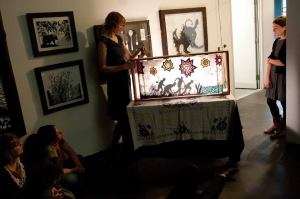
Katherine performing one of her crankies at the opening of her paper cut and shadow puppet exhibit at The Creative Alliance in Baltimore, with Anna Roberts Gevalt and Elizabeth Laprelle.

Katherine performing one of her crankies at the opening of her paper cut and shadow puppet exhibit at The Creative Alliance in Baltimore, with Anna Roberts Gevalt and Elizabeth Laprelle.

CC: What were some of the challenges in designing Saudade? 

KF: I have a lot of experience working with other artists, but have become accustomed to just coming up with a show on my own from start to finish. It was different to have to stop and ask Cecilia what she meant and try to see things through her eyes. We spent a good amount of time editing scenes together so that they could be translatable to shadow puppets and a crankie.

I was eager to cut things out and assemble things, so I had the get used to just drawing and coming up with ideas. I had to wait to see the final product, but then it was exciting to see the pieces finally come to life.
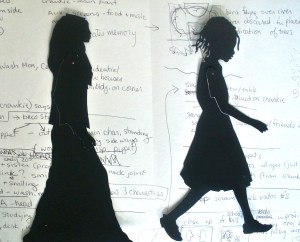
Puppets from SAUDADE on Katherine's sketchbook.

Puppets from SAUDADE on Katherine’s sketchbook.

CC: What was your favorite scene or character to draw and why? 
KF: I enjoyed exploring the aesthetics and folk art of the various cultures and incorporating this into the designs. My favorite puppets are the heads.
Large head puppets from SAUDADE, designed by Katherine.

Large head puppets from SAUDADE, designed by Katherine.

Katherine Fahey (right) and Cecilia Cackley at the opening of SAUDADE in D.C.

Katherine Fahey (right) and Cecilia Cackley at the opening of SAUDADE in D.C.

We’re Going to Canada!

Wit’s End Puppets is taking to the road! Or the plane, as a matter of fact. We have been invited by the good folks at the University of Manitoba’s Mauro Center for Peace and Justice to perform Saudade at the Winnipeg International Storytelling Festival in May.

This is the first time we have been able to take a larger show to an out-of-town event, so we are extremely excited! Since we wrapped up our INTERSECTIONS run, we have been making some changes to the show, adding puppets, polishing scenes and revising sounds to better achieve the effects and images in our minds. We received lots of excellent feedback from our audiences at the Atlas, and have been considering how best to incorporate audience suggestions. The show has a new ending, several interludes that break up the stories of our three main characters and we are working towards creating recorded monologues to begin and end the show that will feature the voices of many of the people whose stories were captured and shared in the script. Here are a few pictures of the progress we’ve made so far:

Amy is carefully placing the tiny paper birds between these two silhouettes.

Amy is carefully placing the tiny paper birds between these two silhouettes.

A new scene added at the end of show.

A new scene added at the end of show.

The ending images were all cut in one long big piece this time.

The ending images were all cut in one long big piece this time.

We have to carefully cut off the bottom edge to make sure everything matches.

We have to carefully cut off the bottom edge to make sure everything matches.