Too Much Light

Touring a puppet show is always challenging, but when the show in question involves shadow puppets, things become especially tricky.

Shadow puppetry depends on the interaction between light and objects (usually flat cutout puppets made of cardstock). This means that controlling light sources becomes even more vital than it would be for another kind of puppet show. In a theater, that is fairly easy. Most theaters are built without windows, so there’s no extra light spill to interfere with the shadows. But our show Saudade was intended from the beginning to be an outreach show; a piece that is shared in community spaces such as schools, churches, libraries and community centers. And almost all of these spaces have, well, windows.

IMG_5797

The perfect shadow puppet space, with side light on the audience but not the enclosed stage.

When we get to a new performance space on tour that has windows, placing the stage becomes extra important. We’ve had lots of discussions as to how we can achieve the best lighting: do we worry more about light spilling onto the screen from the front and perhaps washing out the shadows? Or do we worry about light spill from behind, which could distort the shadows or reveal certain images before they are intended to be seen?

IMG_2622

This was a good setup–no windows behind the stage & blinds that blocked most of the side light.


Sometimes we attempt to cut off the light with curtains, venetian blinds, or shutters and hope for the best. Often we are setting up the show a good hour before we start, which means that the sun can sink lower in the meantime, finding its way through cracks in the curtain or blind. We have fond memories of how various venues have gone the extra mile to try and block windows, including covering them with trash bags (at a transitional school in Winnipeg, Canada) or with large sheets of cardboard (at a church in Minneapolis). For the record, cardboard works the best.

IMG_2567

This was the pitch black gym that made the kids scream in Winnipeg!

In the end, not all light spill is terrible. It can be helpful to have just a little bit of light as we go through scene changes and prepare puppets for upcoming moments. It can also help the audience feel more comfortable. We did one show in Winnipeg at an after-school program where we were performing in a gym with no windows and it was pitch black when the lights first went out. Not only did that make several of the children scream (whether with fright or anticipation I’m not quite sure) but it meant we had no help whatsoever when trying to find the next puppet if one screen light had gone out and the next one wasn’t on yet. As a result, there were a few fumbles when the wrong puppet was picked up and had to be fixed quickly.

Light is essential to shadow puppetry and controlling it is a must when considering where and how to take a shadow puppet play on tour. We hope this post can help other people with these challenges when taking shadow puppets on the road.


Everything Wrong with This Caja Show

In 2012, I visited Argentina for the first time and I was fascinated when Mara Ferreya, a puppeteer from Cordoba, described a kind of street puppet show that took place in a box. She showed me a photograph, with three people all wearing headphones and looking through their own peephole at some invisible show inside a cardboard box. It didn’t look that hard to make.

Later that summer I made my first attempt at a similar show. I called it the Personal Puppet Show and performed it at farmer’s markets and community events. People liked it, but it was only after I went back to Argentina two years later and took a workshop with Mendoza puppeteer Gabriela Céspedes that I realized all of the things I had done wrong. Here is a list of them.

IMG_6149

1. The box is too shallow. I could only see one side of the box in Mara’s photo and I didn’t realize it had to be a certain depth. Part of the magic of caja lambe-lambe is that the tiny peephole creates a forced perspective for the viewer. This gets ruined, however, if the box isn’t deep enough and the puppets end up too close to the eye. My box is only about 6-8 inches deep which is great for transport, but not for creating a forced perspective.

IMG_6150

2. There are two eyeholes instead of one. This was purely me trying to be fancy. I thought two eyeholes would make it easier to see inside, but it’s actually the opposite. Because everyone has a slightly different distance between their eyes, some people find it much harder to focus, looking through two holes. One peephole per viewer works the best.

3. There is no viewfinder for the puppeteer. Another detail that I missed because I only saw a photo. There should be some kind of window in the back or the top of the box so that the puppeteer can see what they are doing. Otherwise, movement becomes imprecise and easy to mess up. Without a viewfinder, my puppeteering isn’t as good as it could be.

IMG_6151

4. There is a curtain at the back, instead of holes for the puppeteers hands. Another mistake that causes practical problems for puppeteering. Trying to smoothly move my hands (and puppets) between pieces of fabric is difficult and it’s easy for the cardboard puppets to get stuck. This creates a jerking motion as they enter the scene, which ruins the illusion of movement. Most boxes have holes for the puppeteer’s hands either at the back or the side, with a curtain over the top to block the light spill. It is much easier to place a puppet in front of this curtain and then enter the box, rather than trying to do both those movements at once. Another option if your puppets are on vertical rods is to cut the holes in the top of the box and bring the puppets in from above.

IMG_6152

5. The box isn’t created with a single show in mind. This is the biggest mistake I made, and it’s arguably the one that takes the Personal Puppet Show out of the category of caja lambe-lambe. A true caja show is a miniature world, one that is constructed for the purpose of telling one short, 1-3 minute story and that story alone. The walls, the floor, the ceiling, the puppets, the soundtrack–all of these should combine to create the illusion of a complete setting. My box, with its one-color walls, black curtain background and plain floor does not do this.

Despite (or perhaps because of) my many mistakes, I enjoyed building my Personal Puppet Show and felt very much at home with the style of puppetry. After studying with Gabriela Céspedes and building a second show as part of the 2015 Fringe project I Thought the Earth Remembered Me I was only more convinced. This year, I’m looking forward to premiering my third caja show, called Library Love and demonstrating how much I’ve learned since I first built the Personal Puppet Show.

In Progress Photos: Selkie

A series of photos showing the progression of our Selkie puppet, from the first tests we created for rehearsals to a workshop performance. This puppet was built by Genna Beth Davidson and Krista Duke and performed by Amy Kellett and Krista Duke.

IMG_5396

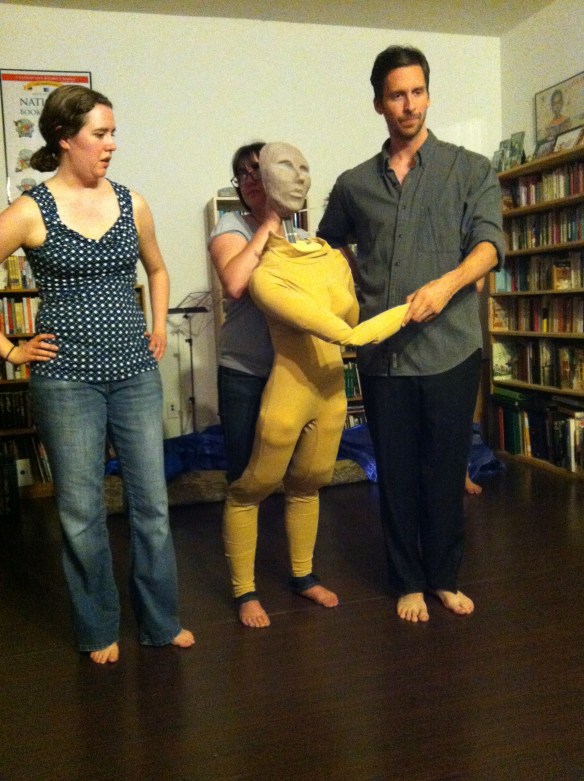
Headless and armless, Krista tries out a dance move with Chris. Photo by Cecilia Cackley.

IMG_5533

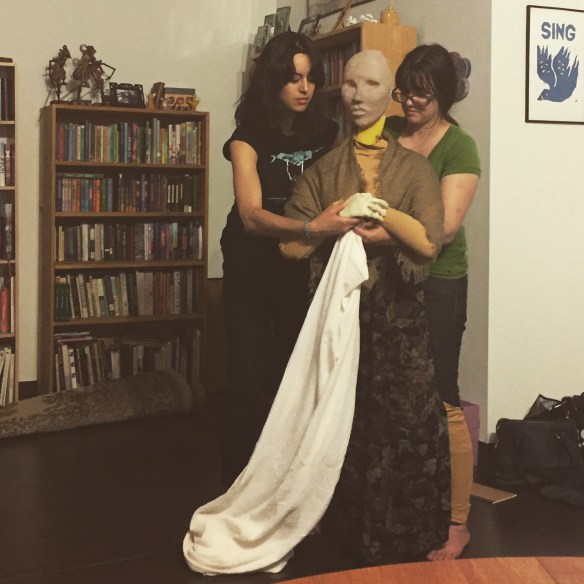
Selkie has a head now, sculpted in clay and then cast in latex. Pat is working out the choreography with Amy and Chris, which is challenging when the puppet has no hands.        Photo by Cecilia Cackley.

IMG_5555

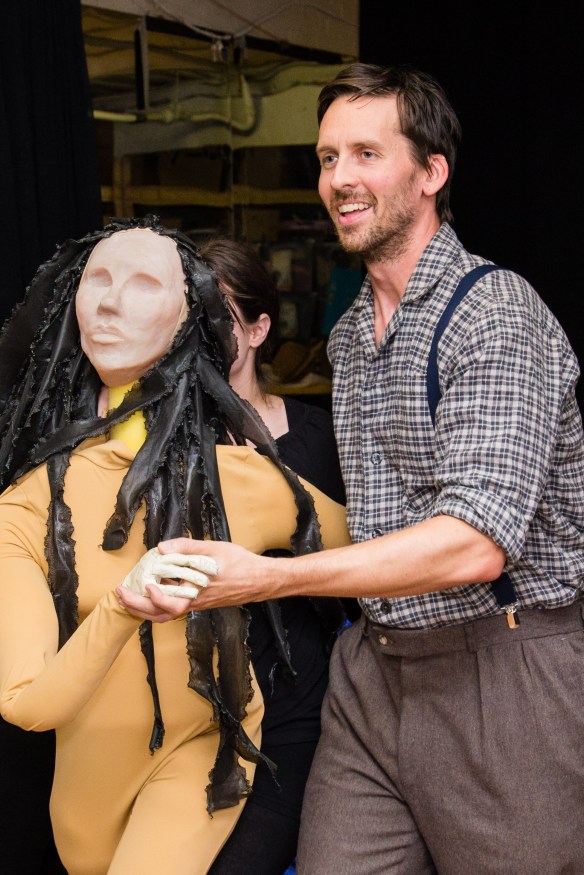
Selkie now has a neck, hands and clothing and is being operated by two puppeteers (Krista Duke and Amy Kellett) instead of just one. Photo by Annalisa Dias

WitsEndSelkie20170522-061

In the workshop performance, Selkie (operated by Amy Kellett) dances with her husband (played by Chris Herring). Photo by David Moss.

Puppet Postcard #1

Flashback time! Back in January, Cecilia was part of a delegation sent by Theater Communications Group to the Santiago a Mil theater festival in Santiago de Chile. As usual, Cecilia kept an illustrated journal of her travels, including encounters with puppets. These first two are from Mendoza, Argentina, where she spent a weekend catching up with Gabriela Cespedes and hanging out watching caja lambe-lambe shows in the plaza.

IMG_5182

img_5197.jpg


Touring Minneapolis

We completed one of our long-time goals for the company this year, taking the show Saudade on an out-of-state tour to Minneapolis, Minnesota. We chose the city because of its strong local puppet scene, anchored by In the Heart of the Beast Puppet and Mask Theater, which was kind enough to put us in touch with one of our venues. After six shows in five days, we were tired, but very satisfied with our work. Here are some photos of the shows and our adventures.

IMG_5735

We had to take apart the crankie box and reassemble it when we arrived, always a slightly nerve-wracking task!

img_5766.jpg

St. Paul’s Lutheran Church, which put up this lovely bilingual sign, had us speak to their arts and leadership youth group before the performance.

IMG_5765

The backstage view at St. Paul’s Lutheran Church.

img_5767.jpg

One of the kids from the youth arts group at St. Paul’s tries out a puppet after the show. “It’s not too hard–you just have to get the hang of it!” he told a younger kid.

IMG_5778

The beautiful arch at The Southern Theater, a building that has seen many changes.

IMG_5806

Genna Beth, Cecilia and Amy at the sculpture ‘Spoonbridge and Cherry,’ part of the Minneapolis Sculpture Garden near the Walker Art Center.

Black Annis Returns

We are very excited to be hard at work again on our show Malevolent Creatures! We first workshopped this piece in the summer of 2014, but it got put on hold for awhile as we focused on building and then performing Saudade. Now we are back at it, exploring the layers of meaning in stories featuring supernatural characters from British folklore.

The first segment of the show, which focuses on a witch from Leicestershire called Black Annis was developed and shown as part of a puppet slam at Black Cherry Puppet Theater in Baltimore this past month. Here are a few photos from rehearsals and the performance. Photos are by Cecilia Cackley and Bill Haas.

img_4774 img_4802 black-cherry3 blackcherry2

Summer Days at the Studio

IMG_4225It’s been four years since we started Wit’s End Puppets and for all that time, we’ve been operating primarily out of a house in the southwest quadrant of Washington DC. Each person on the team had her own workspace at home, but meetings and large building projects, from covering flats with recycled paper, to gluing together a 60ft cranky, happened in the living room of that house.

This summer, we said goodbye and moved our boxes, puppet sets and building materials to a new studio in the Brookland neighborhood. At first, the space looked like it does in the photo above. It took a lot of time and effort, but we’ve finally made progress and everything is (mostly) organized. Here you can see the two sides of the room, with materials and tool storage and plenty of surfaces to work on. Here’s to another four years of creativity and passion, collaboration and puppet magic!img_4530

img_4531